














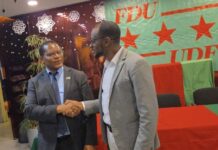



A coalition of 79 Congolese civil society organisations and public interest attorneys, operating under the name MOSSAC (Mobilisation for the Safeguarding of Congolese Sovereignty and Autonomy), has issued a powerful warning. In a declaration dated 26 May 2025, the group denounces the ongoing peace negotiations between the Democratic Republic of the Congo (DRC), Rwanda, and the United States, led by the Trump administration. According to MOSSAC, the so-called “peace accord” is nothing more than a cover for foreign economic control and the erosion of Congolese sovereignty.
A peace agreement under foreign pressure
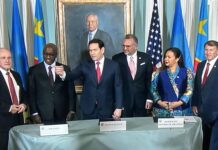
The coalition’s statement responds to the “Statement of Principles” signed on 25 April 2025 in Washington, under the supervision of the US Secretary of State, by representatives of both the Congolese and Rwandan governments. The framework being negotiated proposes an exchange of peace for access to DRC’s strategic mineral wealth. Massad Boulos, Donald Trump’s Senior Advisor for Africa, has promoted the deal as a “minerals-for-security” arrangement.
But for MOSSAC, this is a dangerous illusion. What is being crafted, they argue, is “a deal of business interests, influence, and exploitation, disguised as diplomacy”, one that does not serve the Congolese people and instead entrenches foreign dominance over eastern Congo.
Goma and Bukavu under occupation
MOSSAC reminds the international community that the cities of Goma and Bukavu, the capitals of North and South Kivu provinces, are under military occupation by Rwandan-backed militias M23 and AFC. The coalition points to the statement made on 18 May 2025 by Colonel Kanyami Bwalewa of the M23, who said: “The war is not over because we have not yet achieved the objective.” This, despite a recently announced truce, illustrates the lack of credibility of any peace process that does not begin with a full military withdrawal.
The M23 and AFC, both supported by Rwanda, are accused of systematically looting mining sites and smuggling minerals into Rwanda, where they are laundered and sold as Rwandan exports. According to UN experts, at least 40 mining sites were already under M23 control by 2023, with the number likely far higher today.
Five essential demands from MOSSAC
MOSSAC sets out five key principles that any legitimate peace agreement must fulfil:
- Clear requirements and neutral monitoring mechanisms for a ceasefire: No agreement should move forward without a verified and immediate withdrawal of all foreign forces and militias.
- An end to impunity: There must be no amnesty for war crimes, sexual violence, forced recruitment, or the looting of natural resources.
- A democratic and inclusive process: Congolese citizens and institutions must be directly involved in the development and ratification of any agreement.
- Full restoration of sovereignty over territory and resources: Joint management of Congo’s rivers, parks, and mineral supply chains with Rwanda is unacceptable.
- Military independence: No foreign mercenaries or integration of rebel fighters into the Congolese army should be allowed.
Dr Denis Mukwege, Nobel Peace Prize laureate, is cited in the document as warning against negotiating under threat of arms. He insists that only justice can lead to sustainable peace. MOSSAC also reminds the public that in 2022, the Congolese Parliament formally prohibited the integration of terrorist groups into national defence and security services.
A business deal in disguise
According to MOSSAC, the agreement would grant Kigali and Washington access to Congolese resources under the pretext of joint development. Provisions for co-managing national parks like Virunga and Kahuzi-Biega, joint hydroelectric projects, and the involvement of American investors in eastern Congolese mining operations are seen as thinly veiled attempts to legalise the exploitation of Congolese wealth by foreign powers.
The coalition also denounces the reported plan to use private military contractors to secure mining sites, including companies linked to Erik Prince, the controversial founder of Blackwater. For MOSSAC, this amounts to the privatisation of national security, placing Congolese territory under the control of profit-driven foreign actors.
An existential crisis for the DRC
The coalition’s conclusion is stark: if implemented, the current deal will erode the DRC’s control over its land, economy, resources, and armed forces. Instead of bringing peace, it will provide a legal framework for ongoing foreign occupation and extraction, benefitting Rwanda, armed proxies like M23 and AFC, and Western powers seeking access to critical minerals.
MOSSAC calls on the Congolese Parliament to demand full transparency and for citizens to mobilise peacefully to defend national integrity. For the coalition, the current negotiations do not represent peace, but surrender. A true agreement must be based on justice, sovereignty, and the will of the Congolese people—not on pressure from foreign powers or elites seeking personal gain.












 and Rwanda, under the direction of the Trump administration of the United States. In a “Declaration of concerns”, the Coalition warns that the current negotiations pose an existential crisis for the DRC, in which its sovereignty over its borders, territories, resources, economy and military are being undercut by Rwanda and the US.)