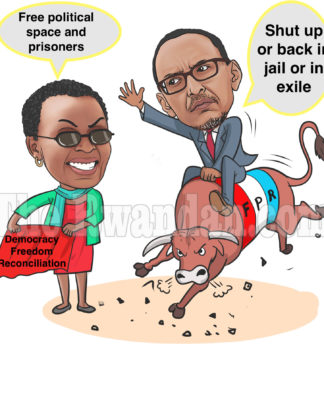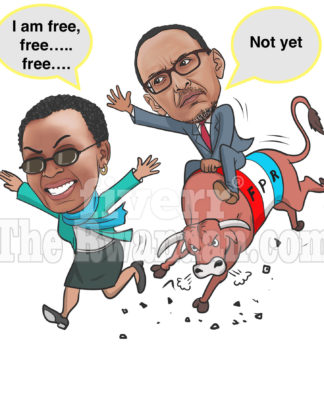























A coalition of Rwandan opposition groups, civil society organisations and independent personalities in France has issued an open letter to French Foreign Minister Jean-Noël Barrot, calling on Paris and the European Union to take concrete action over the imprisonment of opposition figure Victoire Ingabire Umuhoza.
The signatories argue that Ingabire’s detention is political in nature and reflects a broader pattern of repression against peaceful opposition in Rwanda. They warn that Western diplomatic language, which often frames such cases as ordinary judicial matters, risks echoing the narrative promoted by Kigali.
Political criminalisation presented as ordinary justice
The letter criticises French diplomatic statements referring to legal proceedings linked to Ingabire’s past declarations and alleged ties to the FDLR armed group. According to the authors, this formulation reproduces the official rhetoric of Rwandan authorities and blurs the distinction between peaceful political dissent and security threats.
They insist that no independent national or international court has established operational links between Ingabire and the FDLR. The conflation of political opposition with security risks, they say, has already been condemned by the European Parliament, which has called for her release and denounced political repression in Rwanda.
The 1994 genocide: essential memory, but not a permanent alibi
The signatories reaffirm the central and non-negotiable recognition of the 1994 genocide against the Tutsi as a national tragedy. However, they argue that the genocide should not be used as a permanent justification for restricting political freedoms.
Thirty years on, they denounce what they describe as the systematic use of genocide memory to disqualify dissenting voices and restrict democratic pluralism. Several international organisations, they note, have criticised this trend as an authoritarian drift.
Detention recognised as arbitrary at the international level
The letter recalls that the UN Working Group on Arbitrary Detention has classified Ingabire’s detention as arbitrary and called for her release, citing violations of her fundamental rights.
It also describes the obstacles faced by her political party, DALFA-Umurinzi, including refusal of official registration, harassment and arrests of members, bans on meetings, and pressure on activists, independent journalists and online content creators critical of the authorities.
In this context, the authors argue that referring merely to “restrictions” on political space fails to reflect the reality faced by Rwanda’s opposition.
Formal alerts left without substantive response
The signatories state that the French Ministry of Europe and Foreign Affairs has been formally contacted twice regarding Ingabire’s case. These communications highlighted the political nature of the charges, the lack of fair trial guarantees and the systematic criminalisation of peaceful opposition.
They express concern that these alerts have not resulted in a substantive public response, raising questions about the coherence and credibility of France’s diplomatic posture.
Calls for concrete European-level action
The letter urges France to raise Ingabire’s case actively within the Council of the European Union and to support targeted measures under the EU human rights sanctions regime, often referred to as the Magnitsky framework. Such measures would target individuals identified as responsible for political repression.
The authors argue that diplomatic dialogue would gain credibility only if accompanied by visible political action at the European level, in line with existing European Parliament resolutions.
Memory, justice and freedoms: a necessary coherence
While acknowledging the legitimacy of Franco-Rwandan memory work, the signatories warn that it must not become a moral shield to avoid naming current human rights violations. On the contrary, they argue, a credible memory policy should reinforce demands for justice, the rule of law and political pluralism today.
A credibility test for French and European diplomacy
The open letter concludes that France’s reputation on human rights depends on its willingness to clearly recognise the political nature of Ingabire’s imprisonment and to use existing European and international mechanisms.
For the signatories, the case of Victoire Ingabire is not only a Rwandan domestic issue but a concrete test of Western commitment to democratic principles in Africa. They call on the French government to act in line with its international commitments and the values it claims to defend.