











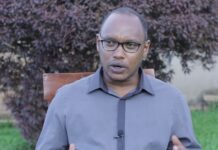


The Democratic Republic of the Congo (DRC) has endured a history of external exploitation, beginning with King Leopold II’s brutal rule and extending to modern-day conflicts fueled by leaders like General Paul Kagame. Dr. Theogene Rudasingwa underscores this continuity, stating, “The same forces that once plundered the Congo under colonial rule have adapted their methods, now operating through regional actors such as Kagame and his Rwandan-backed militias.”
During the colonial period, King Leopold II established a brutal regime in the Congo Free State, exploiting its vast rubber and mineral resources at the cost of millions of lives. The post-independence era did not bring relief; instead, it ushered in new forms of neo-colonial control. Patrice Lumumba, the first Prime Minister of the newly independent Congo, was assassinated in 1961 with Western complicity, paving the way for Mobutu Sese Seko’s three-decade rule. “Mobutu served as the perfect intermediary for Western interests, ensuring Congo’s wealth remained accessible to foreign powers while his own people suffered,” notes Rudasingwa.
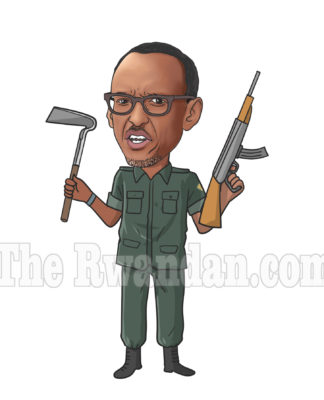
The fall of Mobutu in 1997, orchestrated by a regional coalition led by Rwanda and Uganda, marked the beginning of a new era of conflict. Laurent-Désiré Kabila, who took power with Rwandan backing, quickly fell out with his former allies. In response, Rwanda supported the formation of rebel groups such as the Rally for Congolese Democracy (RCD) and later M23, with the goal of maintaining influence over the resource-rich eastern Congo. “Kagame’s involvement in the DRC is not about security concerns, as he claims, but about economic and geopolitical dominance,” Rudasingwa asserts.
The resurgence of M23 in recent years, culminating in the capture of Goma in January 2025, is a continuation of Rwanda’s strategic use of proxy forces to destabilize its neighbor. Reports from the United Nations and human rights organizations have documented Rwandan military support for M23, despite Kagame’s denials. “The international community has long turned a blind eye to Rwanda’s actions in the DRC because of Kagame’s cultivated image as a development success story,” says Rudasingwa. “But the reality is that Rwanda’s prosperity is built on the blood and resources of the Congolese people.”
Economic exploitation remains central to Rwanda’s involvement in the DRC. Coltan, a mineral essential for global electronics manufacturing, is extracted in eastern Congo under the control of armed groups linked to Rwanda. “Rwanda has no significant deposits of coltan, yet it is one of the world’s top exporters of the mineral. This is direct evidence of the systematic plunder of Congo’s resources,” Rudasingwa explains. Gold and diamonds follow a similar pattern, with Rwanda acting as an illicit transit hub for minerals smuggled from Congolese mines.
Kagame’s ambitions extend beyond economic gain; his long-term goal is the expansion of Rwandan influence over eastern Congo. “His vision of a Greater Rwanda involves the gradual integration of Kinyarwanda-speaking populations in the DRC under Kigali’s control, effectively redrawing borders to serve his strategic interests,” Rudasingwa warns. This policy has led to massive displacement of Congolese communities and violent clashes between local populations and Rwandan-backed militias.
The response from African institutions and the international community has been inadequate. The African Union (AU), the East African Community (EAC), and the Southern African Development Community (SADC) have failed to take meaningful action against Rwanda’s aggression. “African leaders must recognize that Kagame’s actions set a dangerous precedent: if one country can annex territory and exploit another with impunity, no nation is safe from similar predation,” Rudasingwa emphasizes.
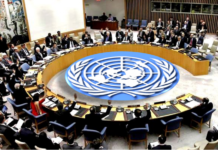
The failure of MONUSCO, the United Nations’ peacekeeping mission in the DRC, further complicates the crisis. Despite billions of dollars spent over decades, MONUSCO has been unable to prevent M23’s advances or protect Congolese civilians. “The United Nations’ failure in Congo is not accidental; it reflects a broader pattern of international inertia when powerful actors stand to benefit from conflict and instability,” Rudasingwa argues.
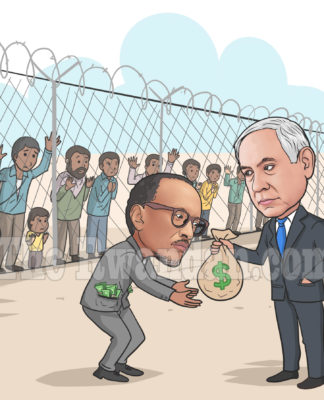
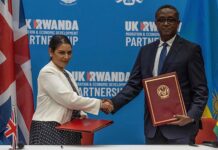
Western nations, particularly the United States and the United Kingdom, bear significant responsibility for Kagame’s unchecked actions. “Washington and London have shielded Kagame from accountability, providing him with financial aid, military support, and diplomatic cover,” Rudasingwa asserts. This backing has emboldened Rwanda to continue its destabilization efforts without fear of consequences.
To address the crisis, Rudasingwa outlines key measures that must be taken. “First, Rwanda must be issued an unambiguous ultimatum to cease its support for M23 and withdraw from Congolese territory. Economic and diplomatic sanctions should be imposed on Rwanda if it fails to comply,” he suggests. Additionally, he calls for Rwanda’s suspension from international bodies such as the African Union and the Commonwealth of Nations until it respects Congolese sovereignty. “We must also establish a joint EAC-SADC military force capable of securing eastern Congo and enforcing Rwanda’s withdrawal,” he adds.
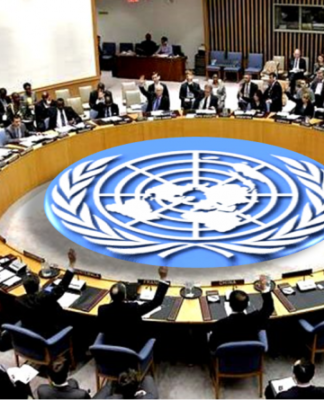
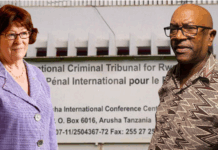
Another crucial step is ensuring accountability for war crimes committed in the DRC. “The 2010 UN Mapping Report, which documents mass atrocities, must be fully implemented before the UN Security Council, and Kagame must be held accountable for crimes against humanity,” Rudasingwa insists. He also calls for a comprehensive arms embargo on Rwanda to limit its ability to sustain military aggression.
“The history of the DRC, from King Leopold II to Paul Kagame, is a continuous tale of betrayal, plunder, and violence,” Rudasingwa concludes. “Africa must break this cycle by standing up to predatory leaders and reclaiming the dignity and sovereignty of the Congolese people.” His call for action underscores the urgent need for regional solidarity and international accountability to finally bring peace to the DRC.