



















The arrest of Barafinda Sekikubo Fred, Mazimpaka Patrick and Nkeramihigo Japhet by Rwanda’s Investigation Bureau (RIB) on 29 January 2026 highlights once again the government’s zero-tolerance approach to dissent and uncontrolled public speech. The three men are accused of spreading “rumours likely to cause unrest or disturbances among the population” through various YouTube channels, a charge that reflects the broad and ambiguous language increasingly used to criminalise online expression in Rwanda.
In its statement, the RIB warned citizens against using social media “in ways contrary to the law” and insisted that it would not tolerate anyone who uses digital platforms to commit offences. Such warnings are a familiar feature of Kigali’s security discourse, where the boundaries between legitimate public debate, political criticism and criminal activity remain deliberately blurred.
The case of Barafinda Sekikubo Fred is particularly revealing. In 2020, after failing to respond to a summons, he was detained and later transferred to the Caraes Ndera psychiatric hospital for evaluation. The authorities subsequently announced that he was suffering from a mental illness that made him unfit for prosecution, and later described his condition as chronic. They even urged media outlets and individuals to stop engaging with him, citing his mental health status.
Human rights advocates have long criticised this practice as a form of political stigmatisation, whereby dissident or unconventional figures are discredited by being portrayed as mentally unstable rather than engaged on the substance of their views. Pathologising dissent serves not only to neutralise an individual politically but also to isolate them socially, undermining any potential support or legitimacy.
Barafinda became widely known when he unexpectedly attempted to run in Rwanda’s 2017 presidential election, and again in 2024. On both occasions, the National Electoral Commission rejected his candidacy on procedural grounds, stating that he lacked the required documentation. These episodes unfolded in a political system widely regarded as tightly controlled, where electoral competition is heavily managed and independent or disruptive candidates face structural and administrative barriers.
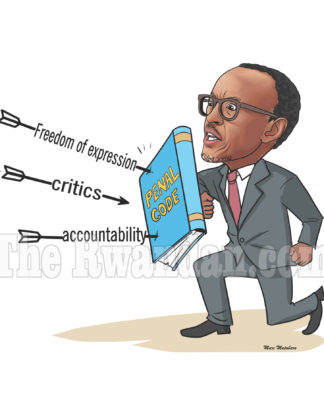
The latest arrests must be understood in the broader context of Rwanda’s expanding legal and security framework governing online speech. Laws on cybercrime and misinformation are drafted in sweeping terms, giving authorities wide discretion to determine what constitutes harmful or destabilising content. In practice, this legal vagueness functions as a powerful deterrent, encouraging self-censorship among journalists, activists and ordinary citizens.
By framing critical or unorthodox speech as a threat to public order, the government continues to conflate state security with regime security. Any alternative narrative, political critique or uncontrolled public voice risks being labelled as destabilising. This approach reflects a political culture that prioritises narrative control and stability optics over pluralism and democratic debate.
The arrests of Barafinda, Mazimpaka and Nkeramihigo therefore go beyond a routine law-enforcement action. They illustrate a broader pattern of information control, intimidation and the narrowing of civic space in Rwanda. Under the banner of preventing unrest, the authorities are reinforcing a climate in which free expression is treated as a liability and dissent as a security risk.
As Kigali tightens its grip on digital platforms, the message is unmistakable: public discourse must remain within the boundaries set by the state, and those who challenge the official narrative, whether through politics, activism or social media commentary, do so at their own peril.