














By Nadia MUGUNGA
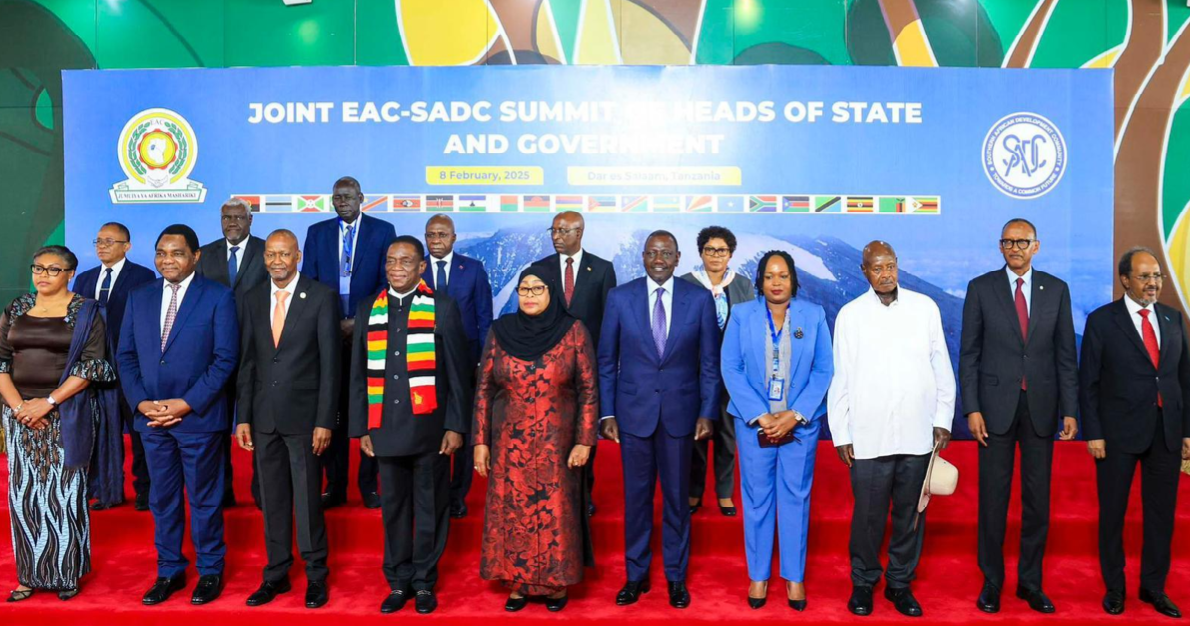
The joint East African Community (EAC) – Southern African Development Community (SADC) Summit concluded on February 8, 2025, in Dar es Salaam, Tanzania, amid heightened tensions in the Democratic Republic of Congo (DRC). The summit sought solutions to the ongoing conflict in the eastern DRC, particularly concerning the M23 rebellion and Rwanda’s alleged military involvement.
Several key leaders were absent from the summit. Burundi’s President was represented by his Prime Minister, Gervais Ndirakobuca. DRC’s President, Félix Tshisekedi, participated via videoconference from the African Union City offices, while his Prime Minister Tuluka Suminwa Judith, represented him in person.
Notable absentees included Malawi’s President Lazarus Chakwera, despite Malawi having lost soldiers under the SADC mission, and South Sudan’s President Salva Kiir Mayardit. Angola’s João Lourenço and Madagascar’s Andry Rajoelina were also missing. South Africa’s President, was among the few major leaders present.
In her opening speech, Tanzanian President Suluhu Samia urged EAC and SADC leaders to rise above their differences and find a lasting solution.
“History will judge us harshly if we do nothing,” she stated, emphasizing the need for an African solution to African problems.
Kenyan President Williams Ruto acknowledged the far-reaching impact of the DRC conflict, stating that the international community must take action and support the Congolese government. “The situation in the DRC is complex but solvable, and this summit must lay the foundation for a better future.”
Zimbabwean President and current SADC Chairperson Emmerson Mnangagwa called for unity, drawing parallels to Africa’s historical struggle against colonization: “We must address this issue with honesty, open- mindedness, and flexibility.”
Despite strong demands from the Congolese government, the summit did not deliver the explicit condemnation of Rwanda for its alleged invasion of Goma, nor did it call for the immediate withdrawal of Rwandan troops from occupied territories. Additionally, no commitment was made to restore Goma fully to Congolese control.
However, Kinshasa did secure some key outcomes, including the reopening of Goma’s airport and critical road networks to facilitate humanitarian aid delivery. While this marks progress, the M23 rebels have not agreed to relinquish administrative control of Goma, keeping the city’s governance in limbo. To address security concerns, EAC and SADC military chiefs are set to meet within five days to develop a stabilization plan for Goma and its surrounding areas.
A major achievement of the summit was the unconditional ceasefire agreement, which all parties—including state and non-state actors—are required to honor immediately. This decision underscores the urgency of halting hostilities and prioritizing diplomatic resolutions over military confrontation (United Nations, 2024).
Additionally, the summit decided to merge the Luanda and Nairobi peace processes, streamlining negotiations under a more coordinated framework, in consultation with the African Union (AU). This move forces Kinshasa into a difficult position, as it has previously refused to engage in dialogue with M23, which it classifies as a terrorist group. Furthermore, Corneille Nangaa , a key M23 figure recently sentenced to death by a Congolese military court and facing an international arrest warrant , will likely be part of the negotiations. This represents a tough diplomatic compromise for the Congolese government, but one necessary in the pursuit of lasting peace.
Another critical outcome of the summit was the agreement on the disengagement of foreign forces. A structured withdrawal plan will be implemented to remove uninvited foreign troops, including those from Rwanda, while also addressing the disarmament of the FDLR (Democratic Forces for the Liberation of Rwanda), a militia group with a history of regional destabilization (Human Rights Watch, 2023).
While Kinshasa did not achieve all of its demands, the summit resulted in significant diplomatic progress, particularly with the ceasefire mandate and the reopening of humanitarian corridors. The upcoming military discussions and the fusion of peace processes indicate a shift towards a coordinated, multi-stakeholder approach to resolving the crisis. However, the real test will be in the implementation and enforcement of these agreements, as past ceasefires have often collapsed due to non-compliance from the warring factions.
The DRC faces an uphill battle, but in the broader context of peace efforts, an immediate ceasefire is a more valuable outcome than a symbolic condemnation.
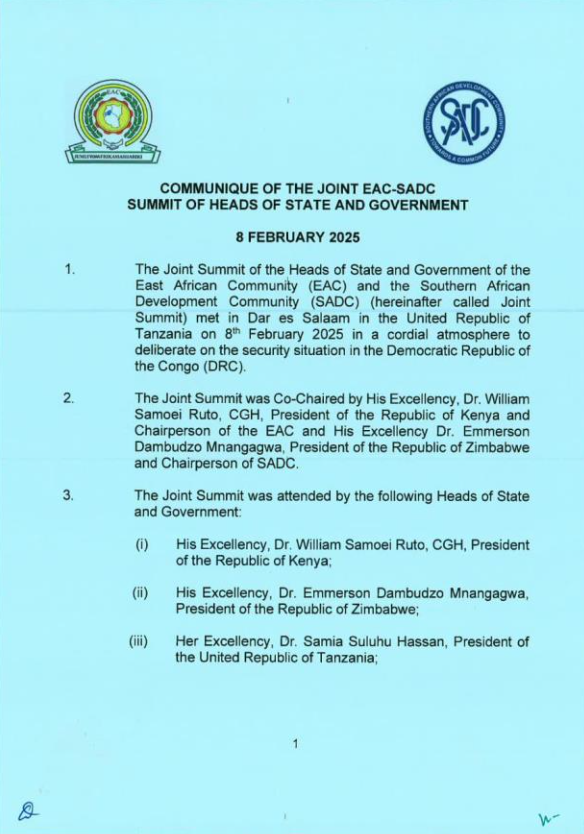
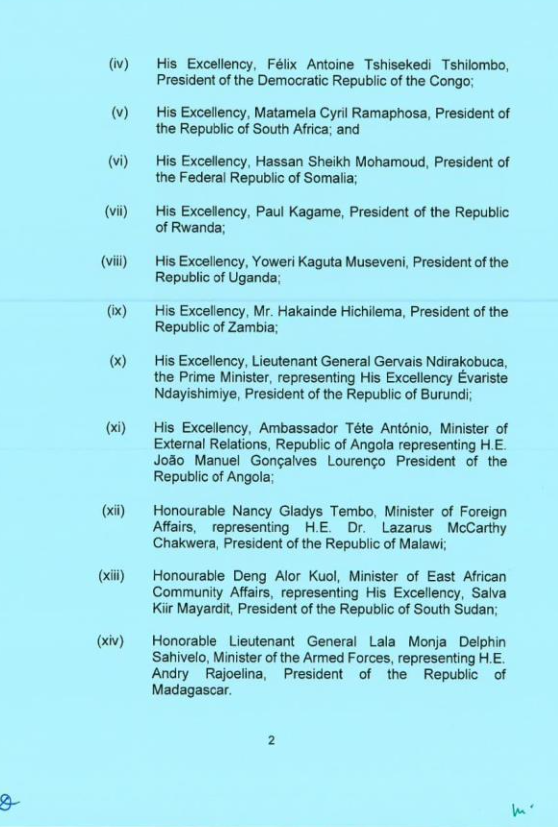
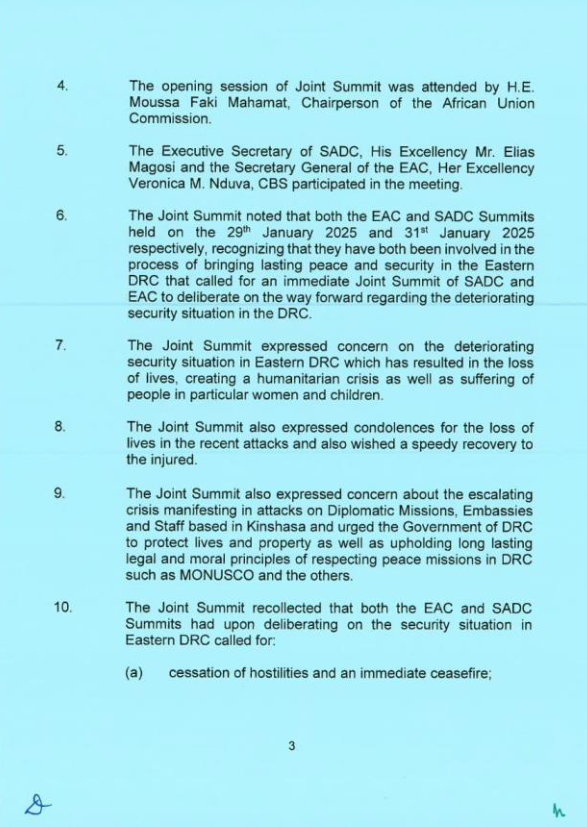
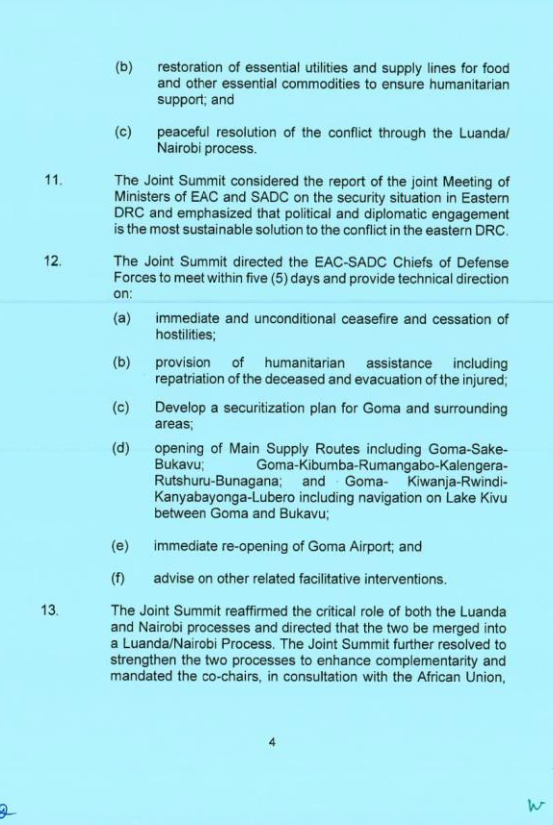
Communique of The joint EAC – SADC Summit of Heads of State and Governement














 Therwandan
