












On January 16, 2025, in Kigali, Paul Kagame addressed members of the diplomatic corps accredited in the Rwandan capital. In a long-winded speech, the Rwandan president once again denounced what he perceives as Western interference in African affairs. While Kigali continues to deny any military involvement in the Democratic Republic of the Congo (DRC), the reality on the ground, corroborated by United Nations reports and intelligence services, paints a completely different picture.
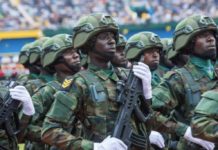
According to diplomatic and military sources cited by The Guardian, thousands of Rwandan soldiers have lost their lives supporting the M23 rebels in eastern Congo. Since the M23 resumed operations three years ago, at least 600 new graves have been identified in the Kanombe military cemetery in Kigali. Satellite images of the site reveal a significant increase in burials, while other Rwandan soldiers who died on the front lines were buried in mass graves inside Congolese territory. For grieving families, the pain is twofold: not only do they lose a loved one, but they must also accept empty coffins when the bodies cannot be repatriated.
The intensification of fighting in recent months has turned into a bloodbath. The battle for Goma on January 27, 2025, resulted in at least 2,900 deaths, according to the UN. Despite these staggering numbers, Kigali continues to deny its role in the conflict. Officially, Rwanda has no troops in the DRC. Yet, mounting evidence suggests otherwise: the Rwandan army directly controls M23 operations. This rebel movement, which has seized territories covering nearly half the size of Rwanda, is in reality entirely under Kigali’s command.
As this situation unfolds, international pressure is mounting on Paul Kagame. A crisis summit is scheduled in Dar es Salaam, Tanzania, where Congolese President Félix Tshisekedi will demand accountability. The massive military losses sustained by Rwanda, revealed by independent sources, make Kigali’s denial strategy increasingly untenable. If so many Rwandan soldiers are dying, it is because their national army is actively fighting alongside M23.
The diplomatic consequences of these revelations could be severe for Paul Kagame. Once seen as a model of stability in Africa, the Rwandan regime now finds itself isolated on the international stage. France, the United States, and several other Western nations, once unconditional allies, are now hardening their stance. Rwanda, once courted, is now being condemned for its destabilizing role in the DRC.
The failure to conceal this reality is even more evident in Kigali itself. A new wing has been built at the capital’s military hospital to treat wounded soldiers returning from the front lines. The hospital morgue is overwhelmed, unable to accommodate the corpses of fallen soldiers. Meanwhile, the families of missing soldiers are forced to accept closed coffins, without knowing if their loved ones are actually inside.
The mass deaths of Rwandan soldiers in the DRC expose Kagame’s direct role in this war. This conflict, which the Rwandan president attempts to mask with rhetoric of victimization and deflecting Western accusations, is no longer a secret. The evidence compiled by UN experts, Western intelligence agencies, and testimonies from grieving families leaves no room for doubt. Despite official propaganda, Kigali can no longer conceal its involvement: the truth is now written on the gravestones of its own soldiers.