


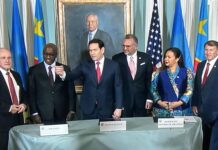




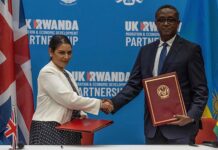













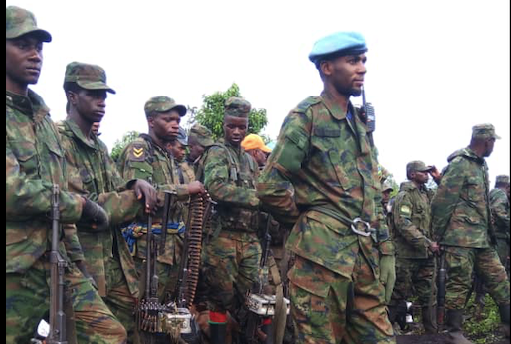
In a letter addressed to U.S. President Donald Trump on July 2, 2025, the Democratic Forces for the Liberation of Rwanda (FDLR) expressed support for the peace agreement signed on June 27 in Washington between the Democratic Republic of the Congo (DRC) and Rwanda. The Rwandan rebel movement, active for over two decades in eastern Congo, described the deal as a “historic turning point” and called for an inclusive political settlement as the only path to lasting peace in the Great Lakes region.
Lieutenant General Victor Byiringiro, acting president of the FDLR, praised President Trump’s personal engagement, as well as the efforts of international stakeholders including SADC, the Sant’Egidio Community, the African Union, the European Union, the UN, and the Church of Christ in Congo. According to Byiringiro, the agreement represents success “where countless actors have failed for three decades.”
But the letter also takes a critical tone. The FDLR accuses the Rwandan government of systematically sabotaging peace efforts and avoiding international mediation. The group highlights its own past initiatives, such as disarmament operations in Kamina (2001) and Kisangani (2014), as well as its involvement in international talks in Rome, Goma, Nyabiondo, and Ntoto.
The FDLR categorically rejects being labelled as genocidal or terrorist, claiming that such accusations are part of a campaign by the Kagame regime to divert international attention from the war crimes and crimes against humanity allegedly committed by the Rwandan Patriotic Front (RPF) since 1990. “We are not a threat to the Rwandan people—we are their voice,” the letter asserts.
The group also denounces a series of joint military operations conducted between 2009 and 2015 by the Congolese army (FARDC), Rwandan Defence Forces (RDF), and MONUSCO, which they say resulted in hundreds of thousands of deaths and mass displacement. Operations such as Umoja Wetu, Kimia I and II, Amani Leo, Amani Kamilifu, and Sokola II are all listed as examples.
The letter recalls the arrest and targeting of several top FDLR leaders—Ignace Murwanashyaka, Straton Musoni, Callixte Mbarushimana, and Sylvestre Mudacumura—describing these actions as part of a wider plan to destroy the FDLR’s leadership and sabotage peace efforts. Murwanashyaka died in German custody in 2019 under unexplained circumstances, while Mbarushimana was acquitted by the ICC in 2011 due to lack of evidence.
The FDLR also condemns the forced and inhumane repatriation of disarmed fighters and their families from DRC to Rwanda in 2018, carried out with the alleged complicity of Kigali. Some of those returned, they claim, were later integrated into the RDF and redeployed in eastern Congo.
According to the FDLR, accusations of atrocities often attributed to them are, in fact, committed by Rwandan forces and falsely blamed on the FDLR in a strategy of deflection. As an example, the group denies involvement in the killing of Italian ambassador Luca Attanasio in February 2021, blaming the ambush on the RPF.
Ultimately, the FDLR argues that their elimination will not solve the core issue, which is political in nature and must be addressed through inclusive dialogue. They insist that they are not responsible for instability in the region and point instead to the RDF as the root cause of ongoing violence across the Great Lakes.
Reaffirming their commitment to peace, the FDLR calls for a secure political space in Rwanda and inclusive talks involving all parties. They state their continued mission is to protect Rwandan refugees in eastern Congo until they can return home safely and with dignity.
The letter was also copied to several African heads of state and leaders of international organisations, including the UN, EU, SADC, and the International Conference on the Great Lakes Region.

















 expressed support for the peace agreement signed on June 27 in Washington between the Democratic Republic of the Congo (DRC) and Rwanda.)