



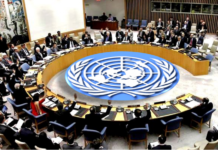








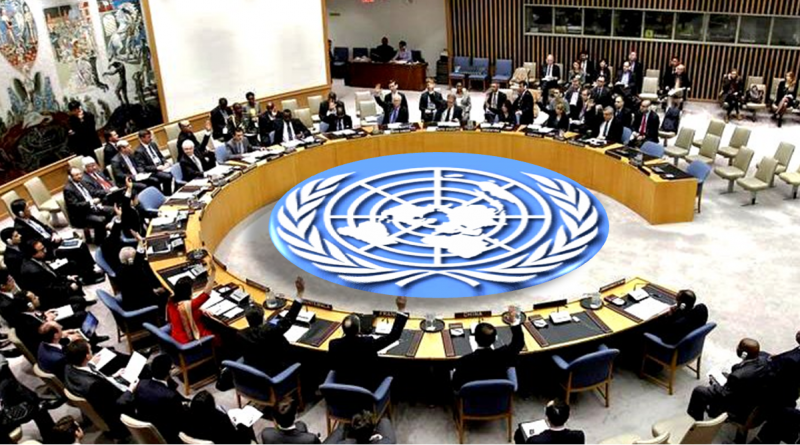
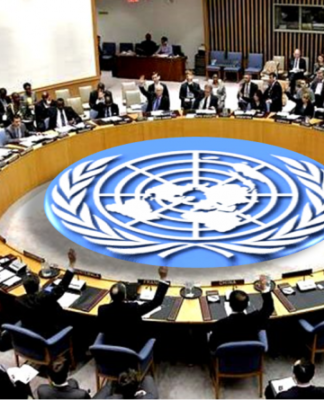
New York, March 27, 2025 — The United Nations Security Council convened on Thursday for a high-level session followed by closed consultations on the escalating crisis in eastern Democratic Republic of the Congo (DRC). The territorial advance of the M23/AFC coalition, backed by the Rwandan Defence Forces (RDF), was at the heart of discussions marked by rising tensions, mounting humanitarian concerns, and growing divisions over the future of the UN stabilization mission, MONUSCO.
Presenting the latest report of the Secretary-General, Special Representative Bintou Keita painted a grim picture of the situation. “The security situation has dramatically deteriorated in the past two months,” she stated, warning that the territorial expansion of the Congo River Alliance (AFC) and M23, with direct Rwandan military support, now threatens not only North and South Kivu, but also the Tshopo and Maniema provinces.
The report details how the M23/AFC has installed a parallel administration in large swaths of eastern DRC, including in Goma and Bukavu. Rebel-appointed governors, deputy governors, and mayors are now administering areas such as Masisi, Rutshuru, Nyiragongo, and Lubero South. The group is also collecting taxes, recruiting combatants, and controlling mining operations — a sign of the deep links between armed conflict and illicit resource exploitation.
The DRC’s Permanent Representative to the UN, Zénon Mukongo, denounced what he called “foreign occupation,” claiming that “more than half of the Rwandan army is deployed on Congolese soil.” He demanded full implementation of Resolution 2773 (2025), which requires the immediate withdrawal of all foreign forces and the disbanding of rebel governance structures. “Not a single RDF soldier has withdrawn. No M23/AFC fighters have left Goma or Bukavu. Quite the opposite — their presence is consolidating daily,” he warned.
Rwandan Foreign Minister Olivier Nduhungirehe rejected these accusations, blaming the DRC for maintaining the FDLR — a group Kigali brands a genocidal militia. He alleged that the DRC has integrated FDLR elements into its army, while the country’s Kinyarwanda-speaking Tutsi populations face systematic persecution. “Without long-term security guarantees, Rwanda cannot afford to scale back defensive measures,” he said.
He also accused MONUSCO of bias, criticizing the mission for failing to address the threat of the FDLR and accusing it of inflating casualty figures. Rwanda, he argued, is unfairly scapegoated, despite being a major contributor to UN peacekeeping.
The United States, MONUSCO’s largest financial backer, responded by condemning what it called “false and dangerous rhetoric” from Kigali. Washington demanded that M23 immediately lift restrictions on MONUSCO and allow humanitarian access. “If the mission cannot fulfill its mandate in M23-held areas, we must consider all options, including revisiting its mandate,” warned Ambassador Dorothy Shea.
France also denounced RDF support to the M23 and reiterated that there is “no military solution to this crisis.” Paris called for the immediate withdrawal of Rwandan troops and urged the DRC to neutralize the FDLR.
The United Kingdom condemned the fall of Walikale and demanded an unconditional ceasefire and the withdrawal of Rwandan and M23 forces. London expressed support for African-led peace initiatives, particularly the Luanda and Nairobi processes, and commended Angola and Qatar for facilitating regional dialogue. However, it regretted that the M23 declined to participate in the latest round of talks.
Russia emphasized that a political resolution would be impossible without clearly defining the status of the M23. It denounced “fabricated narratives” from Rwanda and M23, including claims of Romanian military involvement, and called for a new mandate for MONUSCO.
Burundi called for an inclusive Congolese dialogue and the disarmament and repatriation of all foreign armed groups.
Beyond the diplomatic rhetoric, the humanitarian toll was also at the center of the briefing. Keita reported that 660,000 people have fled recent fighting around Goma, adding to the 6.7 million already displaced nationwide. The fall of Bukavu to the AFC/M23 has suspended the transition plan for MONUSCO’s gradual withdrawal from South Kivu, and ongoing violence has rendered joint UN-government disengagement planning in Ituri and North Kivu obsolete.
In Ituri, the Allied Democratic Forces (ADF) are exploiting gaps left by redeployed Congolese troops, launching deadly attacks in Lubero, Beni, and Butembo. Clashes between CODECO and Zairean armed groups have intensified in Djugu and Mahagi, while a new threat has emerged: former ICC convict Thomas Lubanga has announced the formation of a new politico-military movement, the Convention for Popular Revolution (CRP).
Keita also raised alarm over rising human rights violations. Between December 2024 and February 2025, 403 children — including 90 girls — were victims of grave violations ranging from abductions and killings to forced recruitment and sexual violence.
Access for humanitarian aid remains severely limited due to insecurity, the closure of airports in Goma and Kavumu, and the collapse of banking systems in rebel-held zones. MONUSCO continues to deploy mobile bases in hotspots such as Lodha and Aar, and has facilitated the surrender of 2,216 fighters in Ituri. However, the mission’s freedom of movement remains constrained in M23-held areas, despite minor relaxations.
The security breakdown in the east is now spilling over into western provinces. “Displaced persons are being labeled as infiltrators or suspects, especially Kinyarwanda-speaking Congolese,” warned Keita, citing a rise in hate speech and isolated attacks on Tutsi and Swahili-speaking communities. She urged the Congolese government to adopt a pending law against racism, tribalism, and xenophobia.
In closing, Keita appealed to the Security Council to take “concrete action” against perpetrators and enablers of grave human rights violations. The urgency, she stressed, is not only to halt the bloodshed, but to prevent a broader regional destabilization that threatens to engulf the entire Great Lakes region.










 Therwandan
