
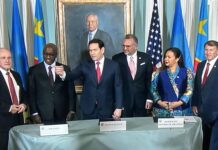







In a major diplomatic and military development, senior military officials from the Southern African Development Community (SADC) met on March 28, 2025, in Goma with the leadership of the March 23 Movement (M23) and its political-military coalition, the Alliance Fleuve Congo (AFC/M23). The meeting, held at the Serena Hotel in Goma, brought together generals from South Africa, Zambia, Malawi, and Tanzania, alongside General Sultani Makenga, the military coordinator of the M23 and head of its armed wing, the so-called Revolutionary Army of Congo (ARC).
The gathering comes amid a full-scale regional war in both North and South Kivu, where M23, backed militarily by Rwanda’s Defence Forces (RDF), has seized control of key cities including Goma, Bukavu, and the Kavumu airstrip. The meeting’s outcomes, officially documented, have raised serious concerns in Kinshasa and among international observers.
De Facto Recognition of M23 Authority
The meeting marks a de facto recognition of M23’s military and political authority in eastern DRC. While the Congolese government continues to label the group a Rwandan proxy responsible for war crimes and regional destabilization, SADC’s decision to engage directly with figures such as Sultani Makenga — who is under international sanctions — signals a shift toward pragmatic diplomacy rooted in the realities on the ground.
Other participants included:
• Gen. Rudzani Maphwanya (South Africa)
• Lt. Gen. Geoffrey C. Zyeele (Zambia)
• Maj. Gen. Ibrahim Michael Mhona (Tanzania)
• Prof. Kula I. Theletsane (SADC Political and Security Affairs)
• Brig. Gen. Bernard Byamungu (Deputy Chief of ARC)
• North Kivu Governor Bahati Musanga Erasto appointed by M23
The government of the DRC was notably absent from the signatories, despite the meeting being held on its territory.
Ceasefire and Withdrawal Agreement on M23’s Terms
The communiqué outlines agreements on a ceasefire and the “unconditional” withdrawal of SADC’s military deployment in DRC, commonly referred to as SAMIDRC. M23 committed to allowing these troops to exit with their weapons and logistical equipment — except for any arms belonging to the FARDC (Congolese army), which are to be left behind. M23 will also coordinate the safe movement of SAMIDRC troops and support a technical assessment of Goma International Airport, with SADC assisting in its rehabilitation.
However, while the agreement may allow SAMIDRC to withdraw its forces and equipment without further bloodshed, it comes at a significant cost — both politically and symbolically.
A Propaganda Victory for M23 and Rwanda
This accord is already being leveraged by M23 and Rwandan authorities as a major propaganda win. A viral video circulating on social media shows Willy Ngoma, one of the M23’s military spokespersons — and a known figure in Rwanda’s broader regional influence network — fraternizing with South African soldiers. In the footage, the soldiers can be seen congratulating Ngoma for allegedly humiliating Romanian military instructors during the M23’s capture of Goma.
The video has been widely shared on Rwandan social media and even reposted by official Rwandan government accounts, symbolizing a perceived victory over SADC forces. For many observers, the footage reflects a troubling breakdown in discipline, poor command structures, and the lack of a coherent rules-of-engagement policy among SAMIDRC troops — particularly the South African contingent.
It has severely undermined SADC’s image, both within Africa and on the international stage. The group is now seen as having been militarily outmaneuvered and diplomatically outplayed by M23/RDF forces, who have demonstrated superior coordination, messaging, and tactical readiness.
Nearly all individuals representing M23 and AFC in these talks — including Sultani Makenga, Bernard Byamungu, and other senior military figures — are under international or regional sanctions for past war crimes, violations of ceasefires, and links to external aggression. SADC’s willingness to negotiate with them raises serious questions about the normalization of impunity and the erosion of international accountability mechanisms.
Regional and Political Implications
The absence of Kinshasa from these negotiations, and the hosting of the meeting in an area under occupation, has sparked outrage among Congolese political leaders and civil society. The perception that SADC — initially deployed to support the DRC — is now negotiating a tactical retreat under the terms of the aggressor, signals a dramatic power shift in the region.
Far from advancing peace, this move may entrench Rwanda’s military and political dominance over eastern Congo, legitimize the M23’s occupation, and set a dangerous precedent for regional diplomacy. It also severely damages the credibility of the SADC intervention, particularly that of South Africa, whose prestige as a continental military and diplomatic power has taken a substantial hit.
What was intended as a technical agreement to ensure troop withdrawal may end up having long-term strategic and reputational consequences. The M23 and Rwanda have already transformed the outcome into a narrative of triumph. Meanwhile, the SADC — especially South Africa — faces growing criticism for mishandling its intervention, both in terms of military performance and diplomatic coherence.
As Kigali and its proxy forces tighten their grip on eastern Congo, the question remains: has SADC simply negotiated its way out of a battlefield defeat, or has it unwittingly legitimized the very forces it was deployed to contain?