





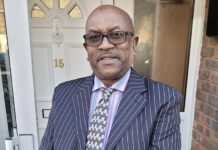
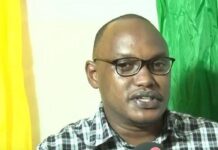

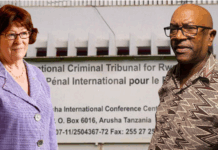
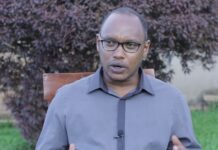

Sultani Makenga, the military leader of the M23, now controls a territory more than twice the size of Belgium in eastern DRC. Sentenced to death by Kinshasa and with a bounty on his head, he remains a key figure in the Congolese conflict. In a rare exception, he granted an interview to Alain Destexhe, a former Belgian senator known for his close ties to Paul Kagame’s regime. Destexhe, who has obtained Rwandan citizenship, is more famous for his media outbursts than for his political work, having been involved in corruption and conflict-of-interest cases from Kinshasa to Paris and Baku.
Instead of interviewing Corneille Nangaa, the political leader of the Alliance Fleuve Congo (AFC), Destexhe chose to speak with Makenga, confirming that the real power within M23 lies with the military, while Nangaa plays a secondary role. However, this interview also exposed a deep contradiction within the movement. While Makenga claims to have no intention of marching on Kinshasa, Nangaa has publicly stated that his objective is to overthrow Félix Tshisekedi. This inconsistency raises serious doubts about M23’s true agenda: is it purely a defensive movement, or does it have broader political ambitions?
Makenga justifies the capture of Goma and Bukavu as a necessary response to attacks by the Congolese army (FARDC) and a measure to protect civilians under M23’s control. However, independent reports indicate that the offensive was planned well in advance and was backed by external logistical support. The fact that M23 managed to defeat a numerically and militarily superior coalition leaves little doubt about Rwanda’s involvement. UN investigations and multiple sources confirm that Kigali has been providing arms, intelligence, and training to M23, despite its official denials.
When confronted with accusations that M23 is a Rwandan proxy, Makenga deflects the question, instead emphasizing historical and cultural ties between the two nations. Yet, his rhetoric mirrors Kigali’s narrative, particularly concerning the FDLR, a group that Rwanda systematically cites to justify its interference in eastern Congo. Makenga also acknowledges the presence of hundreds of thousands of Congolese refugees in Rwanda, a fact Kagame frequently leverages in regional negotiations.
Makenga denies claims that M23 exploits the region’s mineral resources, stating that the movement is “not in the business of minerals.” However, numerous reports have documented the involvement of Rwanda-backed armed groups in the illicit extraction of coltan and gold from Congolese soil. Even if M23 does not directly manage mining sites, it controls trade routes, collects taxes, and secures mining operations. Rwanda, in turn, has long been accused of exporting these minerals under falsified origins.
M23 presents itself as a defense movement but operates as a parallel authority in occupied territories. It has established administrative structures, collects taxes, and regulates movement within its controlled zones. Makenga has expressed support for reopening Goma airport for humanitarian aid deliveries, but he immediately set conditions, claiming the airport is “potentially mined” and needs verification before resuming operations. This tactic effectively allows M23 to maintain control over a critical strategic asset.
Politically, Makenga openly attacks Tshisekedi, calling him a “bandit” and accusing him of using the conflict to distract from his governance failures. He also repeats the claim that Kinshasa planned to attack Rwanda, a narrative that conveniently serves Kigali’s interests. However, the Congolese forces lack the capability and coordination to launch such an operation against Rwanda, making this accusation highly dubious.
The contradiction between Makenga and Nangaa weakens M23’s position in upcoming negotiations. On one hand, Makenga insists that M23 is fighting solely for survival and the recognition of Congolese Rwandophones’ rights. On the other, Nangaa openly advocates for Tshisekedi’s removal. This raises a critical question: is M23 genuinely interested in peace talks, or is it simply buying time to consolidate its power?
The European Union is set to impose sanctions on nine individuals connected to violence in the DRC, and it is likely that figures from M23 and Rwandan officials will be among them. The EU has already summoned Rwanda’s ambassador, demanding Kigali withdraw its troops from Congolese territory and cease its support for armed groups. Makenga calls these sanctions “unjust,” accusing the international community of punishing M23 while ignoring atrocities committed by the FARDC. However, numerous reports have detailed M23’s human rights abuses, including summary executions and arbitrary detentions, increasing international pressure on the movement.
Makenga attempts to portray M23 as a nationalist and federalist force advocating for state reform in the DRC. But in reality, his rhetoric masks an effort to reshape Congo to align with external interests—chiefly those of Rwanda. With a rigid military structure, authoritarian rule over occupied areas, and internal contradictions within its leadership, M23 struggles to present itself as a credible partner in peace talks.
Moreover, while Makenga claims to lead M23’s military operations, he himself takes orders from Kigali, specifically from James Kabarebe, Rwanda’s Minister of State in charge of regional integration. Kabarebe, a longtime Kagame ally, has been sanctioned by the United States for his role in destabilizing the Great Lakes region. Makenga, too, is under international sanctions, reinforcing the argument that M23 is not an independent movement but an extension of Rwanda’s strategic ambitions in eastern Congo.
The fundamental question remains: is M23 a legitimate negotiation partner, or merely a tool in a broader regional strategy orchestrated from Kigali? Its internal contradictions, dependence on Rwanda, and control over strategic territories make it an unavoidable but highly unreliable actor in any peace process.