
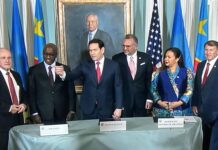


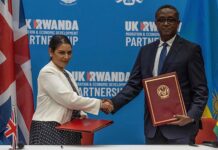











Washington, 27 June 2025 – Under the auspices of the United States, the Democratic Republic of Congo and Rwanda signed a peace agreement in Washington, hailed by Kinshasa as a “historic accord” and a turning point towards lasting stability in the Great Lakes region. The ceremony, overseen by U.S. Secretary of State Marco Rubio, formalised a deal that the Congolese government claims marks the end of “illegal occupation” by Rwandan forces.
According to Kinshasa, the agreement reaffirms the DRC’s sovereignty and ends a cycle of violence that has claimed thousands of lives since 2022. The key provisions include mutual respect of national borders, a phased withdrawal of Rwandan troops, the disarmament of armed groups, the establishment of a joint security mechanism, the repatriation of refugees and internally displaced people, the revitalisation of MONUSCO’s mission, and renewed regional economic cooperation.
Foreign Minister Thérèse Kayikwamba Wagner called the agreement a “victory for multilateralism” and vowed that her government would ensure its effective implementation. Her Rwandan counterpart, Olivier Nduhungirehe, expressed support for the ongoing talks in Doha between Kinshasa and the armed group AFC/M23, widely believed to operate under Kigali’s patronage.
Yet while the diplomatic language is carefully worded, realities on the ground paint a starkly different picture.
M23’s Refusal and Kigali’s Silence
In Goma, the tone is defiant. Ally Musagara, a senior member of the AFC/M23, firmly rejected the idea of any troop withdrawal.
“We’re here, and we’re not going anywhere. What’s being signed in Washington has nothing to do with us,” he said, calling Kinshasa’s statements “disinformation” and urging young people and entrepreneurs to return to a supposedly pacified North Kivu.
On social media platform X, Bertrand Bisimwa, the group’s deputy coordinator, dismissed the accord as yet another Western-driven diplomatic façade:
“International actors have preferred short-term diplomatic ‘successes’, signing deals without ensuring implementation or sanctioning Kinshasa for violations. These agreements are emptied of their substance.”
He denounced the international community’s failure to address the conflict’s deeper ethnic, social and political roots, reducing it to a resource war while populations remain trapped in misery and insecurity.
Another spokesman for the group, Willy Ngoma, went even further:
“We are not concerned with your imaginary and fictitious agreements. We will protect Congolese mineral wealth, a common heritage for all Congolese.”
He accused President Tshisekedi of selling off resources to benefit his own family and vowed that M23 forces would advance to Katanga and even Kinshasa.
Trump, Doha and the Missing Players
In an interview with White House correspondent Hariana Verás Victória, President Tshisekedi openly praised Donald Trump’s mediation and stated he would be “the first” to nominate him for the Nobel Peace Prize if peace with Rwanda is achieved. He lamented the lack of African solidarity, calling the African Union a “hollow shell,” and praised instead the efforts of Qatar, Angola and Burundi.
The agreement signed in Washington was endorsed only by the foreign ministers, not by heads of state. Its full enforcement is expected to be formalised during a follow-up summit in July, when Kagame and Tshisekedi are anticipated to sign a final version.
Notably absent, however, was the AFC/M23. The group was not invited to Washington and is not a party to the agreement. Their involvement is supposed to be addressed in the separate Doha process, which is currently suspended. Delegations from both sides have returned to consult their leaders before talks resume at a later date.
A Deal Meant to Buy Time?
For many Great Lakes analysts, the Rwandan government signed the agreement under U.S. pressure, but with no real intention of honouring it. Kigali is seen as using the process to buy time and strengthen its hold on eastern DRC through the AFC/M23, which continues to control significant portions of North and South Kivu.
Observers stress that nothing can move on the M23 front without Kigali’s approval. The group operates as a proxy, not an independent force. Signing an accord that excludes them may offer diplomatic relief, but it risks entrenching an illusion of peace.
Until the M23 agrees to disarm, withdraw and engage in a serious political dialogue with Kinshasa, the guns are unlikely to fall silent. Washington may applaud its diplomatic achievement, but on the ground, the war isn’t over.