


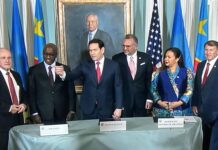













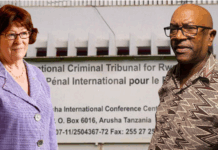






On Friday, 27 June 2025, the Democratic Republic of the Congo (DRC) and Rwanda signed a landmark peace agreement in Washington aimed at ending decades of conflict in eastern Congo. The deal, brokered by the United States, marks a significant diplomatic breakthrough after years of failed efforts and rising tensions. The signing ceremony took place at the U.S. State Department in the presence of Secretary of State Marco Rubio.
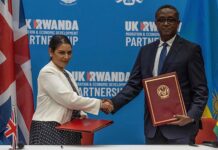
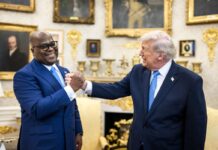
The agreement was signed by Rwanda’s Minister of Foreign Affairs, Olivier Nduhungirehe, and his Congolese counterpart, Thérèse Kayikwamba Wagner. Their handshake, in front of Secretary Rubio and senior U.S. officials, symbolised a renewed commitment to peace. U.S. President Donald Trump, who personally endorsed the negotiations, announced that both Congolese President Félix Tshisekedi and Rwandan President Paul Kagame are invited to an inter-state summit at the White House at the end of July.
A Complex Architecture for a Lasting Peace
The agreement builds on the Declaration of Principles signed by both parties in April. It includes firm commitments to cease hostilities, respect territorial integrity, and halt all support to armed groups operating in the region. A central component is the implementation of the CONOPS (Concept of Operations), a joint plan agreed in October 2024 as part of the Luanda process, aimed at neutralising the FDLR rebel group and lifting Rwanda’s so-called defensive measures deployed in eastern DRC.
“This agreement is based on the irreversible and verifiable end of state support to the FDLR and its associated militias,” said Minister Olivier Nduhungirehe. He acknowledged ongoing uncertainty in the region and warned that implementation would be difficult but stressed that the parties had reached “a turning point” with international support.
Minister Wagner, for her part, highlighted the agreement’s operational aspects: disengagement of forces, protection of civilians, return of displaced populations, and the establishment of a monitoring mechanism. “These are not just words on paper. They must now be translated into concrete actions, with accountability, justice, and political will,” she said.
Joint Security Coordination Mechanism
A Joint Security Coordination Mechanism (JSCM) will be created within 30 days to oversee the ceasefire and the demobilisation of armed groups. The JSCM will coordinate intelligence sharing and joint operations against groups like the FDLR. It will be co-chaired by both countries, with observer status granted to the United States and Qatar.
Under the CONOPS framework, the FDLR is to be neutralised and Rwanda’s military presence withdrawn within three months. Monthly meetings of the JSCM will alternate between Rwanda and the DRC. Detailed reports will be submitted to both governments after each session.
The M23 Question Remains Unresolved
Although the agreement does not mention the M23 rebel group by name, Massad Boulos, President Trump’s adviser for Africa, confirmed that Rwanda has committed to lifting its defensive deployments—an implicit reference to its support for the M23, as alleged by the UN and Western governments. The M23 still controls several key towns in eastern Congo, and a separate peace process with the AFC/M23 is underway in Doha under Qatari mediation. No final deal has been signed there yet.
For now, the group’s continued presence poses a major challenge to peace implementation. According to Pierre Boisselet of the Congolese research institute Ebuteli, “The agreement does not necessarily mean the end of the conflict. We’ve seen in the past that ceasefires are fragile. Fighting can resume at any time if diplomacy fails.”
A Peace Plan With Strategic Interests
Beyond the security dimensions, the agreement also includes an economic roadmap. Within three months, the two nations will launch a Regional Economic Integration Framework linked to existing platforms such as AfCFTA, COMESA, and the East African Community. The framework will focus on energy, mining, infrastructure, and cross-border cooperation, including joint management of Lake Kivu and mineral supply chains.
The United States views this deal as an opportunity to assert its presence in the Great Lakes region, especially in light of growing Chinese influence in the Congolese mining sector. Securing access to strategic minerals—cobalt, lithium, tantalum—is now a U.S. priority. As such, economic oversight mechanisms and anti-corruption tools are built into the deal.
Will This Agreement Be Respected?
History offers reasons for scepticism. In 2004, a U.S.-facilitated tripartite agreement between Rwanda, Uganda, and the DRC failed to deliver on promises of joint border security. In 2023, U.S. intelligence chief Avril Haines travelled to Kigali and Kinshasa to support renewed dialogue, but no lasting peace followed.
This time, the agreement includes a Joint Oversight Committee with representatives from the African Union, Qatar, and the United States, tasked with supervising compliance and mediating disputes. The committee’s first meeting is expected within 45 days.
Still, implementation will depend heavily on political will and trust—two elements that have often been in short supply. The challenges ahead are immense: disarming militias, ensuring the safe return of civilians, restoring state authority, and rebuilding bilateral confidence after decades of mutual suspicion.
Whether this agreement marks the beginning of a genuine peace or becomes another broken promise will depend on what follows in the coming weeks. For now, hopes are high, but caution remains.













 and Rwanda signed a landmark peace agreement in Washington aimed at ending decades of conflict in eastern Congo.)