
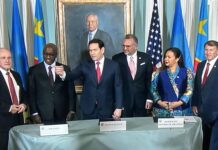



















On March 18, 2025, Rwandan President Paul Kagame and Congolese President Félix Tshisekedi met in Doha under the mediation of Qatar’s Emir, Sheikh Tamim bin Hamad Al Thani. The closed-door meeting was intended to ease tensions and advance diplomatic efforts to resolve the ongoing conflict in eastern DRC. However, as has become a recurring pattern, the three sides—Qatar, Rwanda, and the DRC—issued conflicting statements, each emphasizing different priorities.
Qatar presented the meeting as a step toward confidence-building, highlighting commitments to ongoing peace efforts. The official statement noted that the leaders reaffirmed support for the Luanda and Nairobi processes, backed the recent EAC-SADC summit in Tanzania, and agreed on an immediate and unconditional ceasefire as outlined in the Dar es Salaam summit on February 8. The declaration framed the meeting as constructive, with both Kagame and Tshisekedi expressing gratitude to Qatar for its mediation. However, it avoided assigning blame or mentioning the involvement of armed groups such as M23 and the FDLR.
Rwanda’s version of events took a different approach, focusing on security concerns and the necessity of direct engagement with M23. Kigali emphasized the importance of regional security guarantees and insisted on political dialogue with the AFC/M23 rebels. While reaffirming support for existing peace mechanisms, the Rwandan statement avoided any mention of a ceasefire and instead stressed the need to address threats posed by the FDLR. Kagame reportedly expressed optimism about the prospects for peace but maintained that progress depended on including all key actors in negotiations—particularly M23, which Kinshasa refuses to recognize as a legitimate stakeholder.
The DRC, in contrast, framed the meeting as a major diplomatic breakthrough. The Congolese presidency stated that Kagame and Tshisekedi had both reaffirmed their commitment to an immediate ceasefire and that the specifics of its implementation would be worked out in the coming days through the Luanda and Nairobi processes. However, Kinshasa’s version made no mention of engaging M23 in political dialogue, nor did it acknowledge Rwanda’s security concerns regarding the FDLR.
The conflicting narratives following the Doha meeting mirror past diplomatic encounters between Rwanda and the DRC. Previous summits in Luanda, Nairobi, Bujumbura, and Dar es Salaam have often ended in similar disputes over what was actually agreed upon. While Kinshasa typically highlights commitments to a ceasefire, Kigali focuses on security threats and demands for negotiations with M23. These differences have consistently derailed past agreements and complicated mediation efforts.
The situation was further complicated by a last-minute announcement from the AFC/M23 rebels, who declared that they would not attend the scheduled direct negotiations in Luanda. Despite this, the Angolan presidency insisted that all preparations for the talks remained in place and that both delegations were expected in Luanda. The Congolese government, which had initially resisted direct talks with M23, has not yet responded publicly.
Sources suggest that M23’s decision to boycott the talks was not made independently but was dictated by Kigali. Facing mounting international pressure and sanctions, Kagame reportedly sees the peace negotiations as a bargaining chip to push for a softening of punitive measures. By delaying or obstructing the process, Rwanda appears to be using the talks as leverage to influence the international response to its role in the conflict.
The outcome of the Doha meeting underscores the ongoing challenges in achieving a sustainable peace in eastern DRC. If a ceasefire agreement was indeed reached, its success depends on both sides adhering to it—something that has consistently failed in past attempts. Without clear enforcement mechanisms or a common understanding of what was actually agreed upon, the likelihood of renewed violence remains high.
Qatar’s involvement as a mediator introduces a new diplomatic dimension, but its effectiveness in bridging the deep-rooted distrust between Kigali and Kinshasa remains uncertain. The continued discrepancy in official statements suggests that the fundamental divisions driving the conflict are far from being resolved.