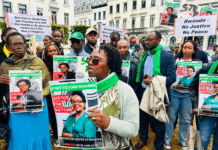
























Yesterday, on 13 May 2025, Rwandan democracy activists once again gathered outside the former Rwandan Embassy in Brussels, marking another chapter in their long-standing campaign for justice and human rights. Despite the breakdown of diplomatic relations between Rwanda and Belgium, the demonstrators remain unwavering in their commitment to speak out against what they call the death of the rule of law in Rwanda.
At the heart of this latest gathering was a discussion on Rwanda’s official genocide commemoration, known as Kwibuka. Participants explored critical questions:
What does Kwibuka mean today? Who does it serve? And does it honor all Rwandans equally?
While the group acknowledged the importance of remembrance in preventing future atrocities, they denounced the current form of commemoration as politically manipulated by the ruling Rwandan Patriotic Front (RPF-Inkotanyi). They argued that Kwibuka promotes a one-sided historical narrative, excluding large segments of the population whose suffering is not officially recognized. According to the activists, attempts to highlight these marginalized voices are often dismissed as denial or revisionism.
They called for an inclusive and truthful approach to memory—one that recognizes the full spectrum of loss and pain experienced by all Rwandans—as the only path toward authentic reconciliation and national healing.

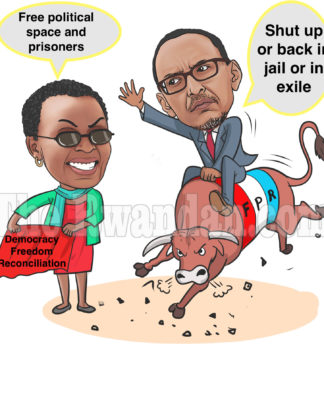
The monthly sit-in held outside the former Rwandan Embassy in Brussels is part of a sustained protest movement that began more than 15 years ago, following the arrest of Victoire Ingabire in Kigali on 21 April 2010. Ingabire, president of the opposition party FDU-Inkingi, had returned from exile to run in Rwanda’s presidential elections. Her arrest provoked immediate outrage among her supporters, particularly within the Rwandan diaspora in Belgium.
On the morning after her detention, protesters gathered at the intersection of Avenue de Tervuren and Avenue des Fleurs in Woluwe-Saint-Pierre, Brussels. There, they formed a human chain demanding her release. As the protest temporarily blocked access to the Rwandan embassy, diplomats called local authorities. The police, recognizing the peaceful nature of the demonstration, asked the protesters to relocate to the opposite side of the street—where they have remained ever since.
Over time, this location has become a symbolic site of peaceful resistance. Every Tuesday from 11 a.m. to 2 p.m., activists erect a protest tent, display banners with messages of solidarity, and advocate for democratic change in Rwanda. The sit-in is organized on a rotating basis by political parties, civil society organizations, and individual human rights defenders, all united in their demand for freedom, justice, and truth.
The protesters’ demands are clear and consistent:
IN RWANDA, THE RULE OF LAW IS DEAD
For Rwanda, we demand:
The message remains unchanged after all these years:
The protest will continue until the Rwandan people—and Rwanda itself—are free.