


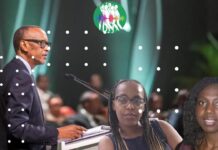




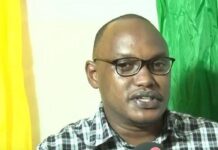
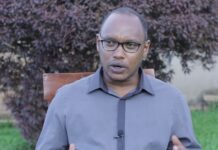
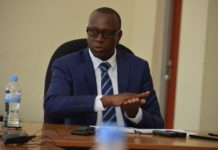
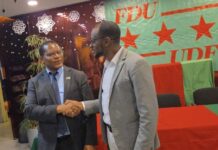
Testimony about the relationship between Col. Karegeya and Kagame. Victor Safari spoke about the challenges his father faced, during the commemoration ceremony held in Brussels in honor of assassinated Rwandan opposition figures.
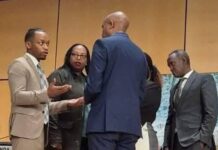
Brussels, June 7, 2025 — A solemn commemoration took place this Saturday at the Church of Saint-Guidon in Anderlecht, Brussels, in honor of several assassinated members of the Rwandan opposition, including Colonel Patrick Karegeya, Hon. Stanley Safari, and Bamporiki Seif. Organized by the Rwanda National Congress (RNC), the event brought together political activists, family members, and supporters to pay tribute to their legacy and call for justice and unity in Rwanda.
The ceremony began with a memorial mass led by Father Athanase Mutarambirwa, followed by a gathering where guests shared reflections and delivered speeches. Among those present were Ali Abdulkarim (RNC Vice Coordinator), Yvan Kigenza (RNC UK Coordinator), Alexis Rudasingwa (RNC Brussels), and Placide Kayumba from the FDU-Inkingi party in Belgium.

Colonel Patrick Karegeya, a former chief of Rwanda’s external intelligence and co-founder of the RNC, was found strangled in a hotel room in Johannesburg in 2013. Although the Rwandan government has denied involvement, suspicions persist, especially following a controversial statement made by President Paul Kagame:
“Rwanda did not kill this person – absolutely not. But I add this: I really wish Rwanda had done it. I really do.”
This remark, made during a national prayer breakfast in Kigali, sparked international outrage and was widely interpreted as an implicit endorsement of the killing.
Stanley Safari and Bamporiki Seif, also affiliated with the RNC, were similarly targeted under suspicious circumstances, particularly in South Africa—a country that has become perilous for exiled Rwandan dissidents. Seif, a young RNC coordinator in Southern Africa, was reportedly assassinated due to his activism and commitment to democratic values.
Frank Ruhinda, brother of Patrick Karegeya, praised the RNC for organizing an inclusive memorial. He emphasized the importance of national reconciliation, challenging the narrative that Rwanda has achieved 95% unity:
“Who exactly has reconciled with whom, if only some Rwandans are allowed to mourn their dead while others are not?”
Ruhinda also warned against the persistent use of ethnic division by the Kagame regime to maintain control, urging Rwandans to identify their common adversary and work together beyond ethnic lines.
Victor Safari, son of Stanley Safari, delivered a heartfelt tribute, describing his father as a joyful, loving, and inclusive man who never taught his children discrimination. He reflected on the broader Rwandan tragedy:
“The Rwandan problem is not impossible to solve, but it requires the courage to face the bitter medicine—truth. Commemoration should not only be a time for mourning, but also for honest critique and learning.”
Ali Abdulkarim acknowledged the legacy of all victims of political violence, regardless of their affiliations, and reminded the audience of their moral duty to honor their sacrifices. He shared a personal story of how Safari had once helped him selflessly during a difficult time in South Africa.
He also spoke about Bamporiki Seif, remembering him as a dedicated and principled young leader whose work was driven by values of unity and justice. Investigations have linked Seif’s murder to operatives of the Rwandan government.

Since 1994, Rwanda has been ruled by the Rwandan Patriotic Front (RPF), led by President Paul Kagame. While the regime is praised for rebuilding the nation after the genocide, it has also been criticized for widespread political repression, assassinations, and human rights abuses. The president’s own words regarding Karegeya’s murder have only deepened global concern about state sanctioned violence.
This year’s commemoration was not just a moment of remembrance, but also a rallying call for unity among the opposition. Several speakers emphasized that Rwanda needs a new political vision rooted in justice, transparency, and inclusiveness.
“Change is overdue,” Frank Ruhinda concluded. “And every Rwandan must ask themselves:
Do I deserve to be part of the Rwanda we hope to build?”
About the Author