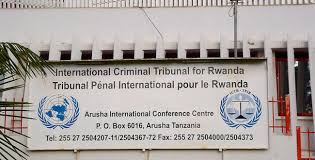






















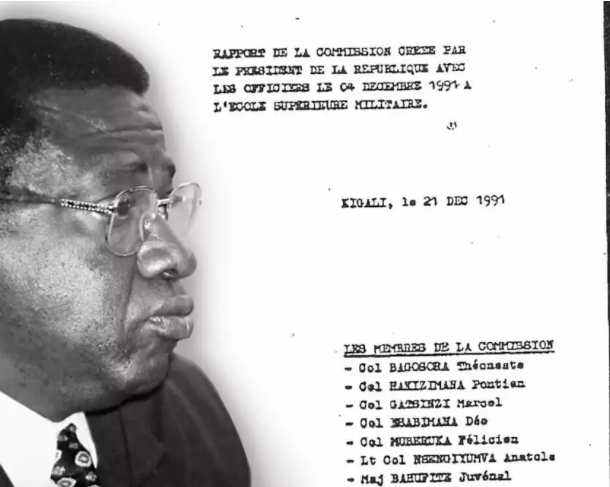
In a groundbreaking publication, Justice Info recently unveiled the full text of the 1991 Rwandan Military Commission report. For over three decades, only a fragment of this report was publicly available. This excerpt served as a cornerstone for the prosecution at the International Criminal Tribunal for Rwanda (ICTR) to establish the alleged conspiracy and planning behind the 1994 genocide of the Tutsi population. With the full report now accessible, its historical and legal implications merit deeper examination.
The Context: Rwanda in 1991
In December 1991, Rwanda was entrenched in a civil war triggered 14 months earlier by the invasion of the Rwandan Patriotic Front (RPF). President Juvénal Habyarimana formed a military commission tasked with advising him on strategies to “defeat the enemy militarily, politically, and in the media.” The commission, led by Colonel Théoneste Bagosora, included ten senior military officers. On December 21, 1991, the group submitted its report to the president.
One part of the report, titled “Definition and Identification of the Enemy,” became infamous for its ethnic undertones. It was central to the prosecution’s argument at the ICTR, which asserted that the document exemplified the planning of a genocidal conspiracy. This excerpt was repeatedly cited in trials, including the landmark cases against Bagosora and Jean-Paul Akayesu.
Judicial Interpretation and Nuance
In the ICTR’s 2008 judgment against Bagosora, the court acknowledged the troubling nature of the report’s language. The judges noted that terms like “enemy” were often used interchangeably with “Tutsi” and recognized the potential for such language to perpetuate dangerous generalizations. However, they stopped short of confirming the prosecution’s claim that the report demonstrated a clear genocidal intent.
The court’s nuanced findings highlighted the broader context in which the commission operated. At the time, Rwanda was actively engaged in a civil war, and defining the enemy was a routine military exercise. The judges rejected the notion that the report unequivocally labeled all Tutsis as enemies or extremists. They also emphasized that several members of the commission later opposed the genocide in 1994, complicating the narrative of a unified conspiracy.
The Historical Legacy
Although the ICTR concluded its work years ago, the historical significance of the 1991 commission report endures. The full report, obtained and published by Justice Info, allows for a more comprehensive understanding of its content and context. It sheds light on the challenges of interpreting historical documents through the lens of justice while grappling with the complexities of intent, planning, and execution.
Lessons for the Future
The release of the full report underscores the importance of transparency in reconstructing history. For decades, the narrative surrounding the excerpt shaped the prosecution’s case at the ICTR. However, as the judges noted, the reality was more complex than the prosecution’s claims of a unified plan. The report is a reminder that history, like justice, is often layered and open to interpretation.
By placing the full document in the public domain, Justice Info has provided scholars, historians, and the public with an invaluable resource. It allows for a critical reassessment of one of the key documents tied to the narrative of the Rwandan genocide, ensuring that its analysis is grounded in evidence rather than speculation.