





















Kigali, March 26, 2025 — Retired Brigadier General Frank Rusagara has died in a Rwandan prison after more than ten years behind bars. Once a respected military officer and senior figure in Rwanda’s post-genocide army, Rusagara’s downfall was not caused by treason or battlefield failure, but by words. Words he spoke in private — but which were deemed unforgivable by a regime intolerant of dissent.
Former Secretary General of the Ministry of Defence and Rwanda’s military attaché in London, Rusagara had been a key member of the Rwandan Patriotic Front (RPF) establishment. But in 2013, he was forcibly retired alongside 78 other senior officers. Just a year later, he was arrested. The charges? Calling Rwanda a “banana republic”, a “police state”, and saying “our guy is finished” — an apparent reference to President Paul Kagame. He also allegedly praised the Rwanda National Congress (RNC), an exiled opposition movement banned by Kigali.
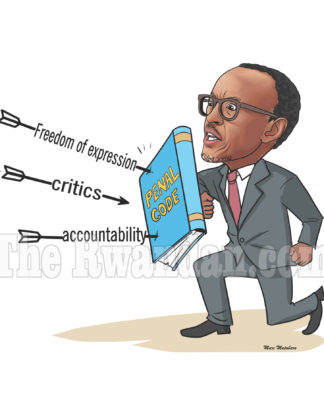
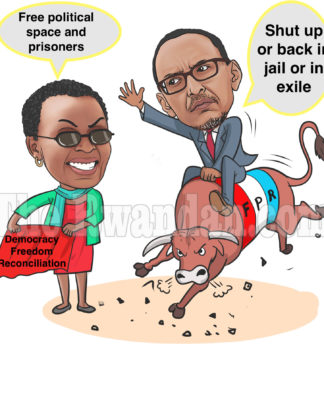
These remarks, reportedly made in private conversations, were brought to the authorities by informants. The military prosecution used them to convict Rusagara of “inciting insurrection” and “tarnishing the image of the government.” During his 2016 trial before the Kanombe Military High Court, Rusagara didn’t deny the statements. He stood by his views, stating that Rwanda had become increasingly autocratic, that it silenced independent voices, and that power had become dangerously centralized around one man.
“Rwanda cannot survive under one mind, one truth, one mouth,” he reportedly said.
For that, he was sentenced to 20 years in prison — later reduced to 15 in 2019. But the sentence was just one layer of the punishment.
A family targeted
Rusagara’s trial and imprisonment cannot be fully understood without considering his family ties. He was the brother-in-law of David Himbara, a former economic advisor to President Kagame who fled Rwanda in 2010 and has since become one of his fiercest critics in exile. Himbara is also the older brother of Colonel Tom Byabagamba, former head of the Republican Guard — who was arrested, tried, and sentenced alongside Rusagara.
Multiple sources — including international observers — believe that Kagame, unable to reach Himbara directly, chose to punish those closest to him. A form of political vengeance by proxy. By imprisoning Himbara’s brother and brother-in-law, the Rwandan regime sent a message: no critic, even in exile, is beyond the reach of consequences.
A quiet death, a broken family
Throughout his imprisonment, Frank Rusagara was cut off from his children — he never saw them again after his arrest in 2014. His wife, Mukankanza, who lived in the UK, fell ill and was hospitalized in her final days. Her dying wish was to speak with her husband one last time. The Rwandan authorities denied that request.
On social media, David Himbara wrote a sorrowful tribute:
“Frank joined his beloved Mukankanza. Do not weep for them. They are watching the stars. They are waiting for us.”
What reads like a poem is also a lament — and an indirect admission that his own freedom may have cost his family theirs.
International condemnation
Rusagara’s imprisonment was condemned by Human Rights Watch, Amnesty International, and the UN Working Group on Arbitrary Detention. All described his trial as unfair, the charges as politically motivated, and the punishment as excessive. Allegations of torture, solitary confinement, and denial of medical care were raised repeatedly — and ignored.
Rwanda’s government, when challenged, simply claimed that the judiciary was independent. In 2019, six British MPs wrote to President Kagame to express concern over the treatment of elderly and ill prisoners like Rusagara and Byabagamba. The then Justice Minister Johnston Busingye brushed them off, stating the executive could not interfere in court cases.
Dying before release
Frank Rusagara was scheduled for release in 2029. He died four years too soon — not freed by the courts, but by death itself. He lived and died as a man who dared to speak out when silence was the rule. And in the end, he paid the price not only for his own words, but for his family ties to a man in exile who dared to challenge Kagame from abroad.
His death closes a dark chapter in Rwanda’s recent history — but not the last. In a system where speaking out is a crime and loyalty is never enough, Rusagara’s fate is a warning to all who dare to dissent: exile protects no one, and silence does not guarantee safety.