








The Forces Démocratiques de Libération du Rwanda (FDLR) have responded to the arrest and extradition of Brigadier General Jean Baptiste Gakwerere, also known as Ezéchiel Gakwerere, Sibo Stany, and Julius Mokoko. This senior officer of their movement was captured in Goma in January 2025, after the city was taken over by the M23 rebels and the Rwandan Defense Forces (RDF). According to the FDLR, this arrest raises many questions about Kigali’s real motivations and the staged operation orchestrated to justify its actions in the Democratic Republic of Congo (DRC).
Last weekend, the M23, which has controlled Goma since January 2025, handed over Gakwerere to Rwandan authorities along with 13 other individuals the rebel group claims are FDLR combatants. However, the true identity of some of these captives remains unclear, and the FDLR denounces this as a manipulation designed to strengthen Rwandan propaganda.
According to ‘Curé Ngoma,’ the FDLR spokesperson, Brigadier General Gakwerere “was part of the high command” of the movement, although he had been inactive for several months due to health problems. He asserts that Gakwerere had taken refuge in Goma to receive medical treatment and was living in hiding. The circumstances of his arrest remain unclear. Officially, he was captured during the takeover of Goma, but some sources claim he had already been arrested and held secretly by the M23 and the Rwandan Army before being officially handed over to Rwanda. ‘Curé Ngoma’ maintains that his health condition prevented him from having any active role in the conflict, which casts doubt on Rwanda’s claim that he was captured while engaged in combat.
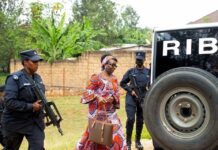
When Rwandan authorities presented Gakwerere to the public, he was dressed in a new FARDC uniform, a detail that raises suspicions among the FDLR. ‘Curé Ngoma’ denounces this as a staged operation meant to fabricate a narrative of collusion between the FARDC and the FDLR. He also claims that several of the prisoners transferred to Rwanda are not members of the FDLR but were used for propaganda purposes. Among the captives is a man identified as Corporal Ishimwe Patrick, whose case illustrates Kigali’s manipulations. According to ‘Curé Ngoma,’ this man has repeatedly been featured in Rwandan propaganda. In January 2025, after the capture of Goma, he was shown in Rwandan media claiming to have defected from the FDLR to surrender to Kigali’s authorities. Yet, he now appears on the list of those officially transferred by M23 as a prisoner. This contradiction exposes the staged media operations orchestrated by the Rwandan regime.
‘Curé Ngoma’ insists that among the 13 prisoners sent to Rwanda, some may indeed be FDLR fighters, but others are merely hostages used to justify Kigali’s expansionist policies. He also accuses the M23 of kidnapping civilians and presenting them as captured fighters to support Rwanda’s propaganda. Gakwerere’s transfer to Kigali comes at a time when Paul Kagame’s regime is attempting to legitimize its military intervention in the DRC under the pretext of fighting the FDLR. For decades, Kigali has used the alleged threat of the FDLR as a justification for its incursions into Congolese territory. However, according to multiple UN reports, Rwanda actively supports the M23, a rebel movement that serves as its proxy to control eastern Congo and exploit its natural resources.
The capture of Gakwerere is conveniently timed for Kagame, who seeks to prove that the FDLR is collaborating with the Congolese army (FARDC). Kigali accuses Kinshasa of supporting this armed group, while Kinshasa, in turn, accuses Kigali of militarily backing the M23. This war of narratives is part of a broader strategy in which Rwanda tries to mask its true intentions: maintaining instability in eastern DRC to consolidate its influence and plunder the region’s wealth.
Asked about the FDLR’s role in the ongoing fighting, ‘Curé Ngoma’ states that their movement is not involved in the battles between the M23 and the FARDC. He explains that while the FDLR is affected by the war, it has not taken part in any offensives. “We are not involved in this war. It is happening in the area where we are based, but we are not attacking anyone. Sometimes, when M23 troops and Rwandan soldiers approach our positions, we are forced to retaliate in self-defense, but we have no active role in this conflict.”
Regarding the accusations against Gakwerere, ‘Curé Ngoma’ emphasizes a fundamental principle of justice: “Every individual is presumed innocent until proven guilty. Just because Gakwerere was arrested and handed over to Rwanda does not mean he is guilty of anything. He must be granted a fair trial if there are charges against him.” He criticizes Kigali for using the personal history of certain individuals to condemn an entire group. “Criminal responsibility is individual. One cannot accuse an entire organization of crimes allegedly committed by some of its members. Yet, this is exactly what Kagame’s regime does by branding the entire FDLR as génocidaires.”
He insists that Kigali’s accusations against the FDLR are merely a pretext to justify Rwanda’s intervention in the DRC. He also points out that Rwandan justice has never investigated crimes committed by the Rwandan Patriotic Front (RPF), particularly those documented in the UN Mapping Report, which details massacres of Hutu refugees in the DRC. “There is a double standard in justice. When it comes to accusing the FDLR, everything moves quickly. But when it comes to the RPF’s crimes, no one wants to talk about them. Kagame manipulates justice to consolidate his power and justify his interference in the DRC.”
‘Curé Ngoma’ concludes by accusing Kigali of using the fight against the FDLR as a smokescreen to conceal its real objective: the looting of Congo’s natural resources.