
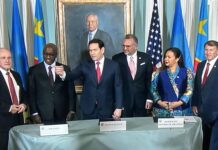





















Washington, April 25, 2025- In the solemn setting of the U.S. Department of State, the Democratic Republic of Congo (DRC) and the Republic of Rwanda signed a Declaration of Principles aimed at opening a new chapter in the troubled history of the Great Lakes region. Under the leadership of U.S. President Donald Trump and Secretary of State Marco Rubio, this diplomatic initiative was strongly supported by the United States, with discreet but strategic backing from Qatar.
The document signed commits both countries to mutually recognize each other’s sovereignty and territorial integrity, to refrain from any interference in internal affairs, to cease all state support for non-state armed groups, and to promote transparent regional economic cooperation, particularly around critical mineral supply chains. It also provides for the voluntary and safe return of refugees and internally displaced persons, renewed support for MONUSCO in accordance with United Nations Security Council Resolution 2773, and the drafting of a peace agreement draft by May 2, 2025.
Presided over by Secretary of State Marco Rubio, the signing ceremony took place in the presence of several senior American diplomats, including Massad Boulos, Senior Advisor for Africa, Christopher Landau, Assistant Secretary for African Affairs, and Ambassador Troy Fitrell.
Secretary Rubio opened the ceremony by highlighting the severity of the crisis in eastern DRC. He stressed that the region had suffered from security instability for more than three decades, hindering peace and sustainable development. “Eastern DRC has been plagued by security crises for over thirty years, preventing the establishment of peace and sustainable development,” Rubio stated. He welcomed the initiative of the Congolese and Rwandan foreign ministers, noting that their presence demonstrated a shared willingness to engage in dialogue to find lasting solutions. “It is essential for me to stand alongside my colleagues, the foreign ministers, to show our collective willingness to engage in dialogue and to seek solutions,” he added.
Rubio also expressed pride in working under the leadership of President Trump, emphasizing Trump’s strong personal commitment to world peace. “I am proud to work with President Trump, who has made promoting peace a fundamental principle and a cornerstone of all foreign policy actions,” Rubio said.
Congolese Foreign Minister Thérèse Kayikwamba Wagner followed with a speech marked by gravity and a strong sense of responsibility. She reminded the audience that the Declaration of Principles marked not an end, but the beginning of a long-awaited journey toward peace. She emphasized that the situation in eastern Congo, marked by massive displacements, chronic insecurity, and serious human rights violations, was a humanitarian emergency. “The realities faced by our people are not theoretical. They are human and call for urgent human responses,” she declared.
She stressed that the signed Declaration was not a symbolic gesture but a serious political commitment anchored in international law, in line with UN Security Council Resolution 2773. This resolution calls for the immediate, unconditional, and verifiable withdrawal of all foreign forces from Congolese territory and the end of support to armed groups. Kayikwamba Wagner warned against another cycle of empty declarations without implementation. “Too many past efforts have failed because actions were delayed and accountability was ignored. The Congolese people deserve better. We cannot afford another cycle of promises without real consequences,” she insisted.
Addressing the Congolese people of the east directly, she stated, “You have every right to expect more than promises. You deserve actions, real peace, and effective justice. Our sovereignty and our territory are non-negotiable.”
Rwandan Foreign Minister Olivier Nduhungirehe expressed satisfaction with the signature, also extending gratitude to U.S. President Donald Trump for his direct involvement in the process. “I thank President Trump for his sincere commitment that enabled the establishment of a climate of dialogue capable of addressing the real roots of instability in eastern DRC,” he said. He emphasized that the discussions were not merely about managing symptoms but about resolving the deep causes of conflict. “Today, we are addressing the real issues, the root causes that must be resolved to achieve sustainable peace,” Nduhungirehe stated.
He highlighted Rwanda’s priorities: restoring security, facilitating the voluntary return of Congolese refugees currently in Rwanda, and building a prosperous, stable regional economy connected to American investors. “It is crucial that we work together on inclusive regional economic development, supported by joint projects and strong partnerships with American investors. Our goal is a stable region, free of ethnic extremism and well governed,” he added.
Nduhungirehe reiterated that the signed Declaration was only the beginning of a longer journey toward a comprehensive peace agreement, reaffirming Rwanda’s support for the ongoing negotiations facilitated by the East African Community (EAC), the Southern African Development Community (SADC), and Qatar. “There are no shortcuts to peace. We must do the hard work, make courageous decisions, and finally resolve this crisis once and for all,” he concluded.
Meanwhile, Qatar’s Ministry of Foreign Affairs published an official statement welcoming the Washington Declaration. Doha recalled hosting the tripartite meeting between the DRC, Rwanda, and the AFC/M23 in March 2025. Qatar emphasized the importance of respecting international law, promoting regional stability, and complementing African and international multilateral processes. Doha reaffirmed its commitment to supporting serious peace initiatives in the Great Lakes region.
U.S. President Donald Trump himself reacted a few hours later on social media. In his message, he wrote: “Big news coming out of Africa, where I am personally involved in settling violent conflicts. We have done an unprecedented job in bringing the parties to resolve their disputes or set them on the path to peace. Stay tuned!” This declaration confirmed that under his administration, African peace processes are becoming a centerpiece of American foreign policy.
As agreed, a draft peace agreement must be finalized by May 2, 2025, based on the ongoing negotiations in Doha. A follow-up ministerial meeting is scheduled in Washington to review and finalize the text. Success will depend on the ability of the parties to turn their commitments into concrete actions: withdrawing foreign armed forces, demobilizing non-state groups, ensuring the safe return of refugees, and establishing credible, transparent economic cooperation.
For the people of eastern Congo, the time has come to demand that words finally become deeds. True peace is not signed in elegant salons; it must be lived, felt, and proven daily, in the towns, villages, and hills where blood has flowed for far too long.