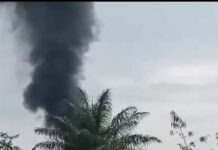












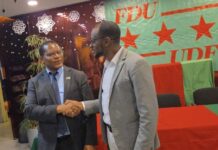


The rally organized on Thursday, February 27, 2025, at Place du 24 in Bukavu by Corneille Nangaa, leader of the Alliance Fleuve Congo (AFC) and a key figure of the M23, ended in tragedy with a deadly explosion. According to initial reports, two detonations occurred shortly after the event concluded. Witnesses state that the first explosion took place about two minutes after Nangaa stepped down from the podium, near the loudspeakers, approximately four meters from the stage. A second blast followed, intensifying the panic.
Videos circulating on social media show lifeless bodies on the ground and injured people being evacuated. Civilians’ motorcycles and vehicles were used to transport the wounded to nearby hospitals. The AFC/M23 has reported a death toll of 11, including a woman and the suspected attacker, as well as 65 injured, six of whom are in critical condition. Corneille Nangaa immediately blamed Kinshasa for the attack. He also announced that the AFC/M23 would cover funeral costs for the victims and medical expenses for the wounded.
In a statement released shortly after the attack, the M23 rebellion claimed that “the order to massacre the people of Bukavu was given by Tshisekedi Tshilombo following a meeting with his last governor expelled from Bukavu.” A serious accusation, aligning with the M23’s well-established strategy of portraying itself as the victim to justify its military actions in eastern Congo.
The Congolese government swiftly responded with an official statement on X. The presidency strongly condemned the attack, calling it a “heinous terrorist act carried out by a foreign army illegally present on Congolese soil.” President Félix Tshisekedi expressed solidarity with the victims and extended condolences to grieving families. He also criticized the rally as a “forced meeting,” referring to the M23’s control over the city and its imposition of the gathering.
However, questions remain regarding the true nature of this attack. Was it an act of internal sabotage, or was it orchestrated to serve a propaganda purpose? Some witnesses reported grenades, but no conclusive evidence has confirmed this theory.
Some analysts suspect a false flag operation orchestrated by the M23 itself. This tactic, frequently used by groups backed by Kigali, aims to provoke a dramatic event to blame the enemy and justify military escalation. The methods bear similarities to those employed by Kagame’s army when it was still a rebellion in the 1990s. At the time, several attacks were attributed to the Habyarimana regime to justify retaliatory actions and strengthen the Rwandan Patriotic Front (RPF).
One key element supporting this theory is that the stage where Corneille Nangaa and other AFC/M23 leaders were standing was not affected by the explosion. If the true goal had been to assassinate Nangaa, why were the blasts directed at the crowd rather than the podium? This inconsistency raises doubts about the real objective behind the attack.
This incident comes at a highly strategic moment. The visit of International Criminal Court Prosecutor Karim Khan to Kinshasa and growing international sanctions against the M23 and Kigali have put increasing pressure on Paul Kagame. This explosion, which allows the M23 to play the victim, could be a maneuver to shift attention and strengthen its diplomatic position.
Since the M23 took control of Bukavu on February 16, 2025, Corneille Nangaa has attempted to consolidate his authority by presenting himself as a guarantor of order. Before the attack, he stated that “special units and patrols would be deployed to ensure security.” But behind this rhetoric lies a different reality: the M23 is nothing more than a tool for Kigali to extend its influence over eastern Congo under the guise of protecting Congolese Tutsis.
Accord to an expert, this strategy is not new. For years, Paul Kagame has used Congolese rebellions as a means to plunder the DRC’s natural resources and weaken its government. Officially, Kigali denies any involvement with the M23, but all evidence points to its direct support: funding, military training, advanced weaponry, and the presence of high-ranking Rwandan officers alongside the rebels. The objective behind the capture of South Kivu is clear: to exploit the region’s vast mineral wealth and keep Kinshasa under constant pressure.
Kagame’s regime, often portrayed as an economic success story, is built on fragile foundations. A significant portion of Rwanda’s budget comes from international aid, while its illegal exploitation of Congolese minerals remains a major source of revenue. Behind Kigali’s polished image, the reality is far different: the country is deeply in debt and relies on looting the DRC’s resources to sustain its economy.
The Bukavu attack is therefore likely part of a well-calculated strategy by the M23 and its sponsors to influence the narrative of the conflict. By portraying itself as the victim of an attack allegedly orchestrated by Kinshasa, the group seeks to distract from its own atrocities and justify an escalation of violence. But the staging is too obvious: it occurs just as Kigali is facing mounting pressure, and the M23 is desperately trying to legitimize its occupation of Bukavu.
«One thing is certain: Kigali and its armed proxy, the M23, are continuing their tactics of manipulation and violence to strengthen their grip on eastern Congo. Kinshasa must remain vigilant and avoid falling into the trap of a rushed response that could be exploited by Kigali to justify further military escalation», concluded the expert