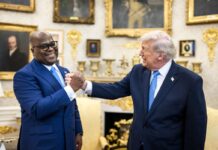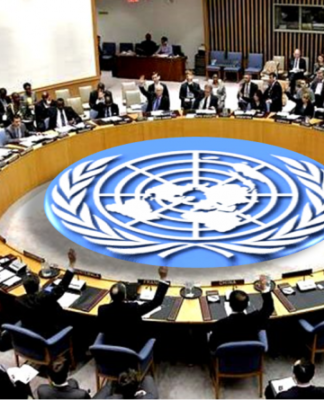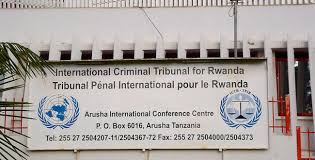

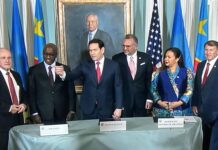



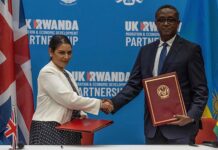













Washington, Friday, April 25, 2025 — Barring any last-minute changes, the foreign ministers of the Democratic Republic of Congo (DRC), Thérèse Kayikwamba Wagner, and of Rwanda, Olivier Nduhungirehe, are expected to sign this afternoon at the U.S. Department of State a Declaration of Principles marking a step toward resuming dialogue between Kinshasa and Kigali. The ceremony is being held under the auspices of U.S. Secretary of State Marco Rubio, who has served in the post since January 2025, and Deputy Secretary Christopher Thomas Landau .
The official signing is scheduled for 2:00 PM, followed by separate bilateral meetings between the two ministers and their American counterparts. However, the full details of the declaration have not yet been made public.
The expected declaration is not a binding agreement but rather a political gesture intended to lay the groundwork for normalized relations between the DRC and Rwanda, whose ties have been severely strained by the ongoing war in eastern Congo. Kinshasa accuses Kigali of militarily supporting the M23 rebellion, an accusation Rwanda continues to deny. The rebel group, now operating under the banner of the Congo River Alliance (AFC), currently controls several strategic zones rich in minerals, including lithium mines.
These developments unfold against the backdrop of increased interest by the United States in securing access to critical minerals for its technology industries. On April 24, Rwanda confirmed that it was in talks with the U.S. over a potential minerals agreement. This followed reports that the Biden administration was also pursuing deeper engagement with Kinshasa on similar grounds.
In an interview with the BBC, Massad Boulos, special envoy of former President Donald Trump for Africa, revealed that several American companies had expressed interest in investing in Congo’s mining sector following his visit to the country. He argued that greater U.S. involvement could help reduce the violence that has plagued eastern Congo for over three decades. President Félix Tshisekedi shares this view, believing that American investment could provide a counterweight to China, whose firms currently dominate much of eastern Congo’s mining landscape.
Boulos, however, made clear that American investment in Rwanda would depend on Kigali withdrawing its troops from Congolese territory and ceasing support for the M23. “Our mission is to promote American interests and advance our vision of international cooperation,” he said, while calling for long-term stability in the region.
In parallel with today’s expected declaration, another peace process is underway between Kinshasa and the AFC/M23. On April 23, following talks facilitated by the State of Qatar, a joint statement was signed by representatives of both parties. Signed in Kinshasa by Papy Mbubi Kangwiji for the Congolese government and in Goma by Lawrence Kanyuka for the AFC/M23, the statement calls for an immediate truce, the rejection of hate speech, and dialogue on the root causes of the conflict.
This agreement comes at a time when the U.S. has taken a tougher stance. In February, the Treasury Department imposed targeted sanctions on James Kabarebe, Rwanda’s State Minister for Regional Integration, for his alleged central role in supporting the M23. Lawrence Kanyuka, the AFC’s spokesperson and senior M23 figure, was also sanctioned, along with companies linked to him operating in the U.K. and France.
These sanctions highlight Washington’s complex dual approach: promoting dialogue while increasing pressure on actors deemed responsible for prolonging the conflict.
In Kinshasa, reactions remain cautious. Civil society groups fear that the declaration with Rwanda could serve to normalize relations without addressing the root issue of M23’s occupation of Congolese territory. In Kigali, however, this diplomatic opening may be seen as a chance for Paul Kagame’s regime to rehabilitate its image amid growing international criticism.
As of now, there is no indication that these parallel diplomatic tracks — between the DRC and Rwanda on one hand, and between the DRC and M23 on the other — will lead to lasting peace. The absence of clear timelines, follow-up mechanisms, or guarantees on troop withdrawals casts doubt on the sincerity of the process.
For Washington, which is trying to redefine its role in Africa amid growing Chinese influence, these initiatives represent a strategic gamble: to make peace a precondition for resource access — even if it means shaking up the local balance of power.