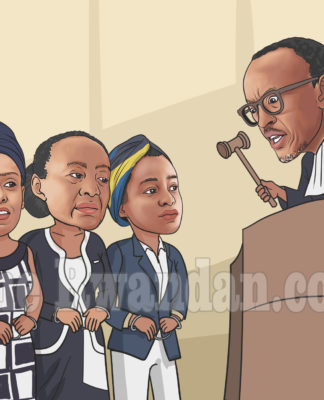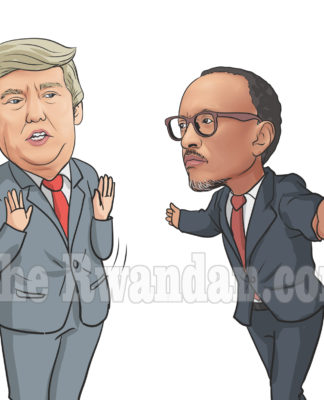













The United States has imposed sweeping sanctions on the Rwanda Defence Force and four of Rwanda’s most senior generals, accusing Kigali of providing “direct operational support” to the M23 rebellion in eastern Democratic Republic of the Congo. The move has triggered sharply opposing reactions: Rwanda denounced the measures as unjust and politically biased, while Kinshasa welcomed them as long overdue recognition of cross-border military interference.
The sanctioned officers include Chief of Defence Staff General Mubarakh Muganga, Land Forces Commander Major General Vincent Nyakarundi, Major General Ruki Karusisi, head of the 5th Division and former Special Operations commander, and Brigadier General Stanislas Gashugi, current Special Operations chief. Their assets under U.S. jurisdiction are frozen, and American individuals and entities are broadly prohibited from engaging in transactions involving them or the Rwanda Defence Force.
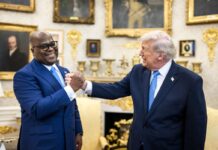
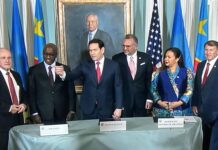
U.S. Treasury Secretary Scott Bessent, announcing the measures, said President Donald Trump was committed to enforcing the Washington Accords signed in December 2025 between President Paul Kagame and President Félix Tshisekedi. Washington expects the “immediate withdrawal” of Rwandan troops, weapons and equipment from Congolese territory.
According to the U.S. Treasury, thousands of RDF troops are deployed in eastern Congo, fighting alongside M23 and supplying advanced equipment including drones and air defence systems. Washington alleges that Rwanda’s military backing has enabled M23 to seize and consolidate control over strategic areas in North and South Kivu, including Goma and Bukavu. The United States further claims that Rwanda’s support has facilitated access to mineral-rich zones, contributing to the financing of M23’s armed campaign.
Kigali has rejected the accusations outright. In a strongly worded statement, Rwanda’s government spokesperson described the sanctions as “one-sided” and accused Washington of distorting the reality of the conflict. The statement insists that Rwanda is acting defensively against hostile armed groups operating in eastern Congo, particularly the FDLR, which Kigali routinely labels a genocidal organisation.
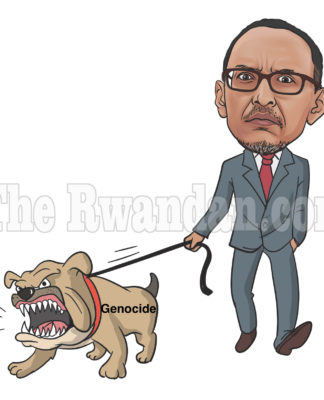
That narrative, however, has become increasingly controversial. While Rwanda presents the FDLR as a direct continuation of the 1994 genocide, the group was formed in the early 2000s, years after the genocide itself. Many of its members were not even born in 1994. The FDLR emerged in the aftermath of the mass displacement of Rwandan refugees into Congo and amid documented massacres of refugees by the Rwandan army and allied militias. Critics argue that branding the entire movement as genocidal has become a political tool rather than a precise legal or historical description.
By invoking genocide rhetoric, Kigali frames its military actions in existential terms. Yet the persistent use of that language has raised questions about whether it serves to shield broader geopolitical and economic objectives. Eastern Congo is not merely a security buffer zone. It is one of the world’s most resource-rich regions, central to global supply chains for coltan, gold and other strategic minerals. U.S. officials have explicitly linked Rwanda’s alleged military support to access to these areas.
For years, the Rwandan government has positioned itself internationally as a guarantor of stability and order. But the latest sanctions challenge that image. By targeting the Rwanda Defence Force as an institution, Washington signalled that it views support for M23 as systemic policy rather than rogue conduct by individual officers.
In Kinshasa, the response was markedly different. The Congolese government welcomed the sanctions as a “strong signal” in defence of its territorial integrity and of the credibility of the Washington peace framework. Officials in the capital have long accused Rwanda of orchestrating M23’s resurgence. For them, the U.S. action represents diplomatic validation.
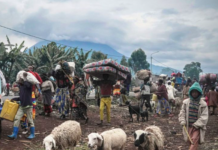
M23’s record adds to the gravity of the accusations. The United States alleges that, with RDF backing, the group has engaged in extrajudicial killings, arbitrary arrests and torture. M23 has denied similar allegations in the past. Nonetheless, its territorial expansion since late 2021 has displaced hundreds of thousands and deepened an already severe humanitarian crisis.
Washington has warned that continued RDF support for M23 risks escalating the conflict into a broader regional war. The concern is not abstract. Eastern Congo has endured nearly three decades of intermittent warfare, drawing in neighbouring states and armed proxies. Each renewed cycle reinforces a pattern in which regional security narratives overlap with economic interests and power projection.
President Trump recently claimed that his administration had ended several global conflicts, including the confrontation between Congo and Rwanda. Yet the latest developments suggest that declarations of peace have outpaced realities on the ground.