


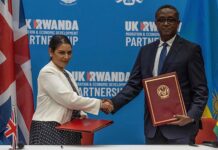










On 22 January 2026, in a formal statement submitted to the United States Congress, Rwanda’s Ambassador to Washington, Mathilde Mukantabana, crossed a political and diplomatic threshold that Kigali had long avoided. For the first time, the Rwandan government openly acknowledged “security coordination” with the Alliance Fleuve Congo/March 23 Movement (AFC/M23), an armed rebel group operating in eastern Democratic Republic of Congo (DRC).
For more than a decade, Rwanda had denied any direct involvement with the M23, dismissing accusations as Congolese propaganda or hostile disinformation. Today, that denial has been replaced by a calculated confession. What the United Nations, human rights organisations and Congolese authorities have described as a proxy war is now being reframed by Kigali as a legitimate security doctrine.
This admission comes at a moment when international law is increasingly challenged by global powers, creating a permissive environment for regional actors to push the boundaries of sovereignty and accountability.
A Carefully Worded Admission Before the U.S. Congress
In her written testimony to the House Foreign Affairs Committee, Ambassador Mukantabana stated clearly:
“For this reason, Rwanda does engage in security coordination with AFC/M23. I state this clearly to build trust through transparency.”
She further claimed that Rwanda’s coordination encouraged the M23 to withdraw unilaterally from the city of Uvira as a demonstration of de-escalation:
“In the aftermath of this escalation, AFC/M23, in order to make clear that they are not the instigators, and with my Government’s strong encouragement, recently undertook a unilateral withdrawal from Uvira, demonstrating commitment to de-escalation.”
These sentences mark a historic shift. After years of categorical denials, Kigali now admits what UN experts have documented since 2012: that the M23 is closely aligned with Rwanda’s military and strategic objectives.
The narrative, however, is carefully constructed. The intervention is framed as defensive, temporary and conditional. The war is rebranded as security cooperation.
The Genocide Narrative as a Geopolitical Licence
To justify this coordination, Ambassador Mukantabana invoked the legacy of the 1994 genocide and the insurgency known as Abacengezi. She referred to the graves of one million victims and argued that Rwanda must maintain defensive capabilities until all threats disappear.
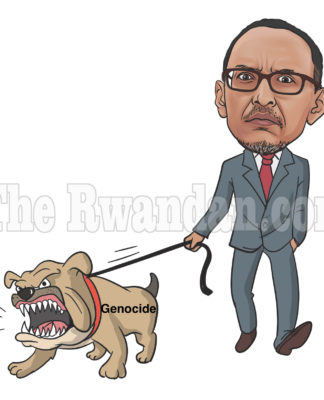
This rhetoric, grounded in a real and horrific historical trauma, has become the central pillar of Rwanda’s foreign and security policy. The genocide is presented as an ever-present threat that legitimises permanent militarisation, cross-border interventions and restrictions on political pluralism.
Yet numerous scholars, journalists and witnesses have documented cases in which violence attributed to opposition groups was allegedly manipulated or instrumentalised by Kigali to justify military campaigns and demonise Hutu communities and political opposition. Incidents such as Bwindi and other atrocities against civilians in Rwanda and the DRC have been cited by experts as possible false-flag operations or politically exploited tragedies.
The genocide narrative, in this context, functions not only as remembrance but also as a geopolitical licence.
The United Nations Tells a Different Story
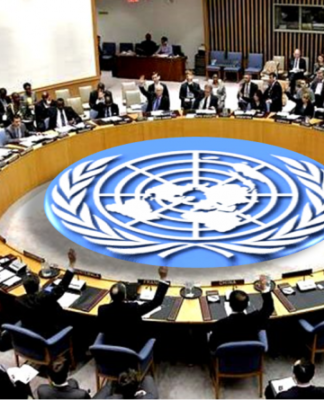
Rwanda’s official narrative diverges sharply from the findings of the UN Group of Experts on the DRC. In its December 2025 report, the UN concluded that the M23 conducts operations with “sustained support and operational coordination” from the Rwandan Defence Force (RDF).
The report details joint offensives, cross-border troop deployments, advanced military technologies and a long-term strategy to consolidate an autonomous region under M23 control in eastern Congo.
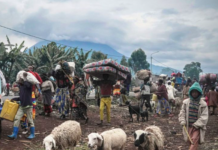
It also documents systematic attacks on civilians, particularly in Hutu-majority areas, including summary executions, sexual violence, forced recruitment and mass displacement. These acts may amount to war crimes or crimes against humanity.
The contrast is stark: Kigali speaks of defence and transparency; the UN speaks of coordinated military operations and grave human rights abuses.
Uvira: De-escalation or Tactical Repositioning?
Rwanda presents the M23’s withdrawal from Uvira as proof of its commitment to peace. But many observers see this move as tactical rather than transformative.
The M23 has established parallel governance structures, imposed taxes, recruited civilians and created courts and police forces in territories under its control. Its leaders have openly discussed the ambition of governing an autonomous region in eastern Congo.
This is not merely a defensive insurgency. It is a political and territorial project.
The War Economy: Minerals and Predation
One striking omission in Ambassador Mukantabana’s statement is the role of natural resources. Eastern Congo is one of the world’s richest regions in critical minerals, including coltan, cassiterite, wolframite and gold.
UN experts have documented that the M23, with Rwandan support, controls significant portions of mining production, creating a transnational war economy. These minerals are essential for global technology and defence industries, making the conflict not only regional but global in its economic implications.
Security rhetoric masks an economy of extraction and strategic resource control.
The Stigmatisation of Hutu Communities
Another troubling aspect of Rwanda’s discourse is the conflation of FDLR fighters, Congolese militias, FARDC elements and Hutu civilians into a single security threat. This narrative fuels collective suspicion and legitimises harsh military operations against entire communities.
UN reports warn that such conflation exacerbates cycles of violence and contributes to mass atrocities. Joint RDF–M23 operations have targeted Hutu-majority areas with scorched-earth tactics, leading to mass displacement and allegations of collective punishment.
A World Normalising the Disdain for International Law
Rwanda’s admission must be understood within a broader global context. Donald Trump’s statements on Greenland, Panama, Canada and recent operations in Venezuela, as well as Vladimir Putin’s invasion of Ukraine, have contributed to a global environment in which international law appears increasingly negotiable.
When major powers openly discuss territorial expansion or conduct unilateral military interventions, they set a precedent. Leaders like Paul Kagame may interpret this as a signal that power politics has returned and that rules apply selectively.
If global powers can redraw borders or challenge sovereignty, why should a regional power refrain from asserting influence in a neighbouring state?
The Ambiguous Role of the Trump Administration
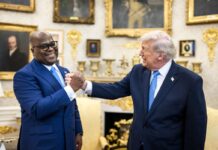
Despite strong rhetoric about peace and stability, the role of the Trump administration in the Rwanda–DRC dossier remains ambiguous. The Washington Accords were presented as a historic breakthrough, yet their implementation has been fragile.
Ambassador Mukantabana praised President Trump, Secretary Rubio and other officials for their leadership in the peace process. Yet Rwanda’s actions on the ground—admitting coordination with a rebel group—contradict the spirit of those agreements.
Kigali appears to be testing the limits of American tolerance. The question is whether Washington will prioritise stability and strategic minerals over accountability and international law.
Transparency or Normalisation of Interference?
By claiming to build trust through transparency, Rwanda attempts to reframe an act of foreign military interference as a responsible security policy. But coordinating militarily with a rebel group inside a sovereign state violates the UN Charter, the African Union’s Constitutive Act and fundamental principles of non-interference.
If this admission carries no consequences, it risks establishing a dangerous precedent: that proxy warfare and cross-border military operations can be openly acknowledged and tolerated.
A Test for the International Order
Ambassador Mukantabana’s statement is more than a diplomatic document. It is a stress test for the international order. If Rwanda faces no serious repercussions, it will signal that international law is optional, especially for strategic allies.
The confession confirms what the UN, NGOs and researchers have argued for years: the M23 is not an independent Congolese rebellion but a strategic extension of Rwanda’s military doctrine.
The question is no longer whether Rwanda is involved, but how far that involvement goes—and how long the international community will tolerate a proxy war justified by an ever-expanding security narrative.