
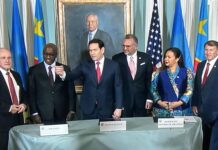














KIGALI – On Tuesday afternoon, Rwandan President Paul Kagame received former Nigerian president Olusegun Obasanjo at his Village Urugwiro offices in Kigali. According to an official statement, the two discussed the regional situation in the Great Lakes, broader African affairs, and global dynamics. The meeting comes amid persistent rumors about Kagame’s health, following nearly three weeks of absence from public appearances.
Earlier this year, Obasanjo was appointed as one of the mediators in efforts to resolve the ongoing conflict in eastern Democratic Republic of Congo (DRC). His visit to Kigali signals that behind-the-scenes diplomacy is continuing, as international actors push to revive a peace process in the volatile Kivu region, where Congolese forces and local militias face off against the M23 rebels, who are widely reported to be backed by Rwanda.
However, the diplomatic significance of Obasanjo’s visit was overshadowed by renewed speculation surrounding Kagame’s well-being. Since his last public appearance on June 6—when he met with students and staff from Hope Haven Christian School in Kigali—Kagame has not been seen in public, fueling rumors of serious illness or even death.
A fake statement, falsely attributed to the Rwandan Defence Forces (RDF), circulated on social media earlier this week, claiming that Kagame’s health was in critical condition. The RDF swiftly denied the authenticity of the statement, labeling it “Fake News” and “false information,” but did not provide further details on the president’s current condition.
Government spokesperson Yolande Makolo, quoted by the Rwandan news outlet Taarifa, attempted to reassure the public, stating, “The president is fine and is taking a regular break,” adding that “there is no reason for concern.”
Despite these statements, uncertainty lingers. Kagame’s prolonged absence has caused unease, even among his loyal supporters. Many who are usually vocal on social media had gone silent in recent days, with some openly expressing anxiety. Others responded with alarming rhetoric, making threats against political opponents and even suggesting that if Kagame were to die, massacres could be unleashed against Hutus—claims implying that he is the only barrier preventing such violence.
Analysts interpret this behavior as a sign of growing insecurity within Kagame’s support base. “The relief shown after the images of the Obasanjo meeting were published is clear evidence that even staunch Kagame loyalists were genuinely concerned. This atmosphere of secrecy reflects how central Kagame is to the regime and how little is known about his succession plans,” said one Nairobi-based political analyst.
As no concrete proof has been offered regarding Kagame’s health, Rwandan authorities now appear determined to regain control of the public narrative. Yet the episode raises broader concerns about the system’s dependency on one individual and the potential instability that could follow a leadership vacuum. Still, without transparency about the president’s health, speculation is likely to persist both inside Rwanda and abroad.