
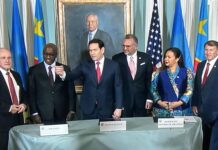



















Washington – On the eve of the expected signing of a peace agreement between the Democratic Republic of Congo (DRC) and Rwanda, the balance appears to be tipping in Kigali’s favour. According to diplomatic sources cited by Reuters, Congolese negotiators have dropped their key demand for the immediate withdrawal of Rwandan troops from eastern Congo — a condition that had until recently been deemed non-negotiable by Kinshasa.
Rwanda’s Foreign Minister, Olivier Nduhungirehe, confirmed that the current draft of the agreement “makes no mention of ‘Rwandan troops’, ‘RDF [Rwanda Defence Force]’, or any immediate withdrawal of ‘defensive measures’.” His remarks directly refute a recent Africa Intelligence article that claimed otherwise.
For months, the international community — with the United States playing a central role — has pushed for a deal to ease tensions between the two neighbours, which flared up again with the resurgence of the M23 rebellion. The group, accused by the UN and multiple diplomats of being backed by Rwanda, has seized key towns and resource-rich areas in North Kivu. Rwanda denies any involvement, insisting its actions are purely defensive, aimed at neutralising the threat posed by the FDLR, a Rwandan Hutu militia long based in the DRC.
Talks have taken a decisive turn in recent days. According to three diplomats and one Congolese official, all speaking on condition of anonymity, the latest draft agreement now proposes a gradual withdrawal of Rwandan forces over several months. This would be conditional on joint or unilateral operations against the FDLR. This softer approach appears tailored to meet Kigali’s terms, which have consistently rejected the idea of a unilateral troop withdrawal.
Rwandan government spokesperson Yolande Makolo confirmed that any lifting of border security measures would depend on the “elimination of the threat posed by the FDLR.”
Kinshasa has yet to publicly respond to this apparent shift. Some analysts believe the Congolese government may have opted for concessions to salvage the broader peace process and attract much-needed Western investment, especially in the mining sector. The draft agreement is said to include provisions for a ceasefire, a ban on support to non-state armed groups, and the creation of a monitoring mechanism to oversee troop withdrawals and the dismantling of the M23.
Economic interests loom large in the background. Washington, acting as chief mediator, aims to stabilise the region and secure access to strategic minerals such as cobalt, tantalum, lithium, and gold — all essential for the global tech and green energy industries.
But critics are already questioning the deal’s effectiveness. One regional analyst observed, “Rwanda has won yet another round in its long game. The end goal remains the same — to annex parts of eastern Congo, either directly or through proxies like the M23. Everything else is just about buying time or removing obstacles.”
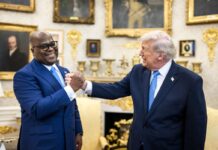
The agreement is scheduled to be signed this Friday in Washington. Yet, without firm commitments on Rwanda’s military withdrawal and the dismantling of proxy forces, there are growing concerns that the deal may be little more than a declaration of intent with limited impact on the ground.