
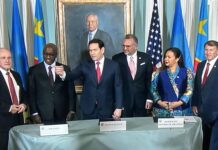




















In Washington D.C., under the auspices of the U.S. Department of State, Rwanda and the Democratic Republic of Congo (DRC) signed a Declaration of Principles, marking an important diplomatic step between the two countries. This initiative, facilitated by U.S. Secretary of State Rubio, aimed to strengthen a shared commitment to peace, despite ongoing tensions in the Great Lakes region.
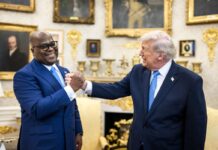
However, one detail did not go unnoticed by observers: the absence of a handshake between Olivier Nduhungirehe, Rwanda’s Minister of Foreign Affairs, and Thérèse Kayikwamba Wagner, the DRC’s Minister of Foreign Affairs. The scene was quickly picked up on social media, sparking various interpretations regarding the true atmosphere of the meeting.
In a post published on X (formerly Twitter), Olivier Nduhungirehe sought to clarify the incident. According to him, the absence of a handshake did not reflect any particular tension during the discussions in Washington. He emphasized that the atmosphere had been “much more consensual” than that of previous meetings in Luanda. He explained that the refusal to shake hands was a personal decision by Minister Thérèse Kayikwamba Wagner, who, since her appointment, has consistently refused to shake hands with any Rwandan official.
The Rwandan Foreign Minister described the gesture as “regrettable,” noting that it went against traditional diplomatic protocols. Nevertheless, he downplayed the incident, stating that it “was not a big deal” in his view.
This absence of a handshake highlights the deep mistrust that continues to define relations between Kigali and Kinshasa, despite formal reconciliation efforts. For years, the relationship between the two countries has been strained, mainly due to mutual accusations of supporting various armed groups operating in eastern DRC.
The signing of the Declaration of Principles is seen as an encouraging diplomatic step. Yet, Minister Thérèse Kayikwamba Wagner’s attitude underscores the difficulty of establishing real trust, even within a diplomatic framework orchestrated by a third power like the United States.
It remains to be seen whether this agreement can truly pave the way for lasting détente between Kigali and Kinshasa, beyond symbolic gestures and official appearances.