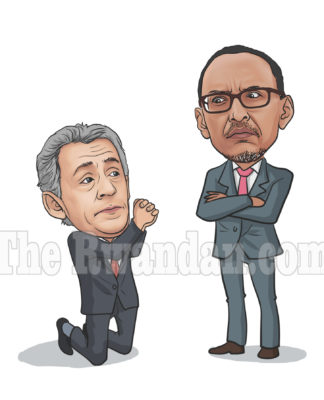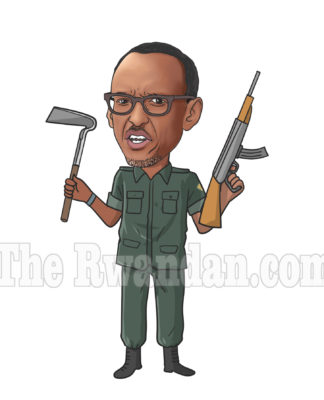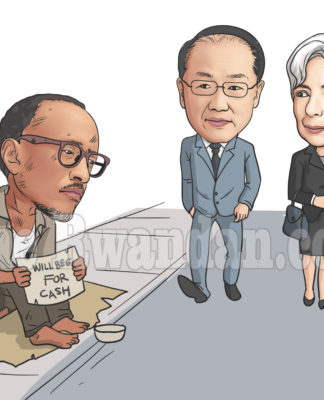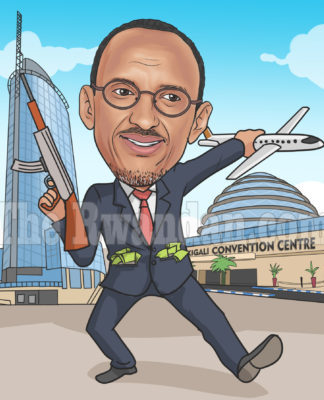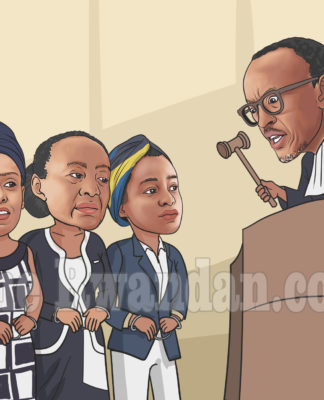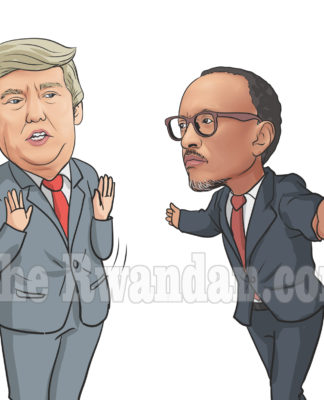











On April 7, 2025, during the 31st commemoration of the 1994 Genocide, Rwandan President Paul Kagame launched a scathing attack on Western powers. In front of a somber crowd of officials, survivors, and diplomats, Kagame accused the United States, the United Kingdom, Germany, Canada, the European Union, and international organizations of hypocrisy, saying, “They can go to hell!” His fury was directed at countries that have imposed sanctions on Rwanda over its military involvement in the war in eastern Democratic Republic of Congo (DRC), where Kigali is accused of directly supporting the M23 rebel movement.
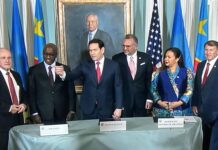
Yet barely 24 hours later, Kagame was all smiles, personally receiving Massad Boulos, Senior Adviser to Donald Trump on African affairs, for a tightly choreographed visit in Kigali. Boulos, accompanied by Rwandan officials and American economist Mauro De Lorenzo, praised Rwanda’s commitment to peace and stability. He visited the Kigali Genocide Memorial and the Mutobo Demobilisation Centre, where he listened to testimonies from ex-FDLR fighters returning from Congo — scenes carefully staged to reinforce Rwanda’s narrative of reconciliation and regional leadership.
In his public remarks, Boulos — like Secretary of State Antony Blinken before him — paid tribute not only to the Tutsi victims of the 1994 genocide, but also to the Hutu and Twa civilians who were killed during the same period. This phrasing, though seemingly inclusive, struck a nerve in Kigali. The Rwandan government considers it a form of revisionism, as it challenges the official version which focuses solely on the genocide against the Tutsi.
Kigali’s discomfort stems from a dark and often overlooked chapter: according to multiple UN reports, including the 2010 Mapping Report, the Rwandan Patriotic Front (RPF) — the former rebel group led by Kagame — committed widespread atrocities against Hutu civilians both in Rwanda and during its pursuit of fleeing populations into Zaire (now DRC). These killings systematic and targeted, have never been fully addressed in Rwanda’s tightly controlled political environment. For Kigali, acknowledging Hutu victims implies facing uncomfortable questions about the RPF’s legacy.
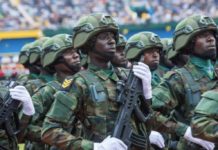
Boulos’s visit, though framed as a peace mission, unfolded entirely on Kigali’s terms. There was no mention of the Rwandan Defense Forces’ (RDF) presence in eastern DRC, nor of the M23’s occupation of towns such as Goma and Bukavu — strategic cities now under the control of forces widely believed to be backed, armed, and commanded by Rwanda.
While Boulos praised Rwanda’s economic vision and commitment to peace, his silence on the ongoing conflict in eastern Congo contrasted sharply with the reality on the ground. More than 7 million people are internally displaced in the DRC, and numerous UN and NGO reports have documented serious human rights abuses by M23 and RDF forces — from mass killings and sexual violence to the recruitment of child soldiers and looting of mineral-rich territories.
In contrast to the well-orchestrated Rwandan visit, Boulos’s stop in Kinshasa felt flat. There were no field visits, no briefings with displaced communities, no exposure to the security challenges Congolese forces face on the frontlines. As one Congolese analyst wrote on X (formerly Twitter): “While Rwanda rolled out a full briefing pack and took him to meet demobilized fighters, we gave him air-conditioned offices and polite smiles. When he returns home with a distorted picture of the region, we will be the first to complain.”
Currently, a tense ceasefire holds along the frontlines in Kivu region, the result of ongoing negotiations in Doha, Qatar, where mediators are attempting to broker a de-escalation. But on the ground, the M23 and RDF maintain control over key territories, and the Congolese government accuses Rwanda of continuing to reinforce its positions.
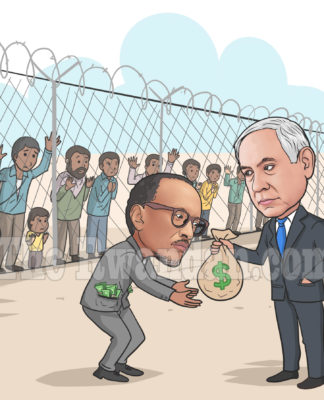
Despite mounting evidence, Rwanda continues to maintain a diplomatic edge. Through carefully managed visits like Boulos’s, Kigali manages to project the image of a responsible regional actor. Meanwhile, the victims of the conflict — Congolese civilians displaced, raped, or killed — remain invisible in these high-level conversations.