




















Kigali, 4 August 2025 – On Monday, the High Court of Nyarugenge heard an appeal filed by opposition leader Victoire Ingabire Umuhoza contesting the decision of the Kicukiro Primary Court, which had ordered her provisional detention. She faces seven criminal charges, including creating a criminal group, inciting public disorder, endangering the government, and disseminating harmful propaganda.
The hearing opened at 9:05 a.m., with her lawyer, Me Gatera Gashabana, raising a procedural objection: the Prosecution had uploaded its response to the electronic case management system at 9:06 p.m. the evening before the hearing. The defence argued that this late filing violated her right to a proper defence and asked the court to strike the document, citing Articles 75 and 87 of the Criminal Procedure Code.
The Prosecution responded by invoking Article 184, which it said does not impose a fixed deadline for responses in appeal matters. The High Court acknowledged the objection and stated that it would decide on the issue in due course.
Contesting the legality of her detention
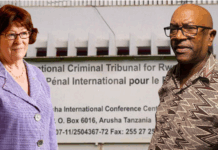
Dressed in prison uniform and wearing her natural hair, Ingabire reminded the court that she had been unable to retain the lawyer of her choice — a Kenyan lawyer who was not granted authorisation to practise in Rwanda. As a result, she is being represented by Me Gashabana, though he was not her preferred counsel.
The defence presented eight main arguments to justify her release and to contest the legality of the lower court’s ruling:
1.Jurisdictional irregularity: Ingabire argued that her arrest was based on Article 106 of the Criminal Code, applied in violation of the Constitution. A request had been filed with the Supreme Court to nullify that article, but the Kicukiro court proceeded with the case regardless.
2.Time-barred charges: She claimed that certain charges, such as spreading rumours and inciting protests, date back to 2021 and are now beyond the legal time limit. She pointed to a 12 October 2021 interview cited in the charges, noting that minor offences should expire after one year. The Prosecution argued the content remains available online, keeping the charges active.
3.Lack of substantial evidence: Some charges, including inciting unrest and threatening state security, were allegedly based on vague or unlawfully obtained evidence. The defence questioned the credibility of key testimony and disputed the legality and relevance of audio recordings. The Prosecution maintained that such recordings are legally admissible in cases involving national security threats.
4.No direct involvement: Ingabire denied participating in any so-called subversive meetings. The fact that members of her unregistered political party, DALFA-Umurinzi, were allegedly involved does not, she argued, amount to personal involvement. The Prosecution, however, pointed to testimony from a former employee who claimed to have been recruited by Ingabire under the pretext of attending English classes.
5.Unsubstantiated conspiracy charge: One of the accusations was based on an exchange with Sylvain Sibomana in which she was referred to as “Mukecuru”. Her lawyer argued this was trivial. The Prosecution stated more evidence would be presented at trial.
6.Illegally obtained recordings: The defence contested the admissibility of certain recordings, though the Prosecution noted that the authenticity of the recordings was never denied.
7.Low risk of flight: Ingabire emphasised her history of respecting legal procedures, including following the conditions of her 2018 presidential pardon and honouring a travel ban, even when her request to visit family was rejected.
8.No risk to the investigation: The Prosecution argued that releasing her could jeopardise the investigation. She reportedly acknowledged that 26 individuals took part in the alleged meetings, but only a few have been arrested. The Prosecution contended that she has not fully cooperated and may interfere if released.
Decision expected on 7 August
The hearing concluded at 1:30 p.m. The High Court announced that it would issue its decision on Thursday, 7 August 2025, at 3:00 p.m.
This high-profile case has reignited discussion about political space in Rwanda, the independence of the judiciary, and the conditions under which opposition voices are allowed to operate in an increasingly restricted environment.