












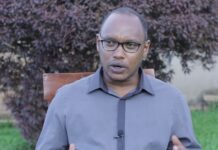

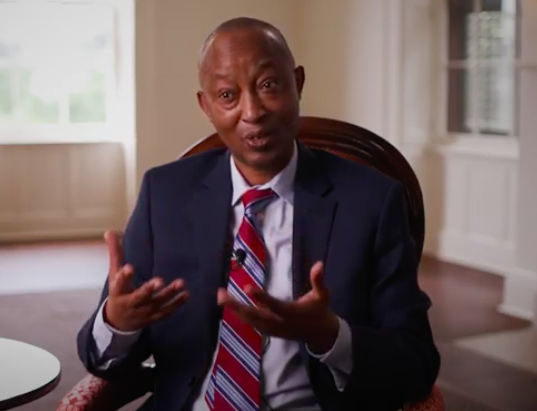
On February 7, 2025, the Heads of State of the East African Community (EAC) and the Southern African Development Community (SADC) will meet in Dar es Salaam, Tanzania, to address the ongoing crisis in the Democratic Republic of Congo (DRC). Ahead of this crucial summit, Dr. Theogene Rudasingwa, a former Secretary General of the Rwandese Patriotic Front (RPF), former Ambassador of Rwanda to the United States, and former Chief of Staff to President Paul Kagame, issued an open letter urging immediate action against Rwanda’s continued military aggression in the DRC. In this strongly worded appeal, he highlights Rwanda’s direct involvement in the recent fall of Goma and condemns Kagame’s persistent denial of his military’s presence in Congolese territory.
The occupation of Goma by the M23 rebels—a militia backed by Rwanda—once again exposes the failure of regional and international actors to prevent Kagame’s repeated violations of Congolese sovereignty. Despite overwhelming evidence, including reports from the United Nations Group of Experts, Kagame continues to manipulate diplomatic engagements while pursuing territorial and economic ambitions in eastern Congo. Dr. Rudasingwa’s letter underscores that Kagame’s war strategy has remained unchanged since 1990: he does not believe in negotiations, peace agreements, or ceasefires except as temporary tactics to regroup before striking again.
Rwanda’s systematic plundering of Congolese resources, including coltan, gold, and diamonds, has funded both its military operations and Kagame’s increasingly repressive regime. These minerals, crucial for global supply chains, are extracted through illicit networks linked to Kagame’s government. Dr. Rudasingwa denounces this exploitation, emphasizing that the war is not simply a territorial dispute but a calculated economic campaign that sustains Kagame’s authoritarian rule. He warns that unless decisive action is taken, this cycle of violence will escalate into a full-scale regional war with catastrophic humanitarian consequences.
The human toll of Kagame’s aggression is immense. Decades of conflict have left millions dead, countless communities destroyed, and millions displaced. The recent offensive by M23 has forced even more Congolese civilians to flee their homes, exacerbating an already dire refugee crisis. Meanwhile, Kagame’s denials of involvement only serve to embolden his forces. In his letter, Dr. Rudasingwa exposes Kagame’s duplicity, calling out the Rwandan leader’s false claims that he is unaware of his troops’ presence in the DRC. These deceptions are part of a long-standing pattern, as seen in Kagame’s previous invasions of the DRC under the pretext of security concerns.
The EAC and SADC, representing a combined population of over 600 million people and a GDP exceeding $1 trillion, have the power to end Rwanda’s aggression. Dr. Rudasingwa reminds African leaders that regional unity has successfully countered Kagame’s expansionism in the past, particularly during Rwanda’s forced withdrawal from Goma in 2012. He urges them to rise to the occasion again, this time to secure a lasting peace rather than another temporary retreat.
His letter lays out specific recommendations:
- A clear ultimatum demanding Rwanda immediately cease all support to M23 and withdraw its forces from the DRC.
- Targeted economic and diplomatic sanctions against Rwanda, including suspension from regional trade agreements.
- The suspension of Rwanda from the African Union and the Commonwealth of Nations until it complies with international norms.
- The deployment of a joint EAC-SADC military force to protect civilians, secure borders, and monitor Rwanda’s withdrawal.
- An international arms embargo on Rwanda, enforced by the African Union and the United Nations, to curb its military capabilities.
- The enforcement of the 2010 UN Mapping Report, ensuring Kagame and his associates are held accountable for crimes committed in Rwanda and the DRC.
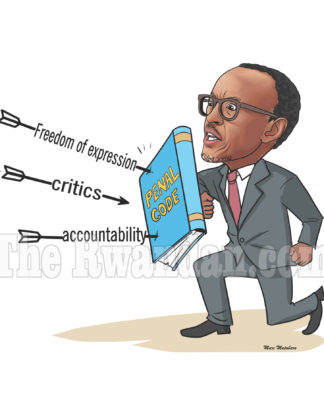
Dr. Rudasingwa does not stop at condemning Kagame’s actions in the DRC—he also calls attention to Rwanda’s internal repression, arguing that Kagame’s external aggression is deeply connected to his need to suppress dissent at home. The persecution of opposition figures, journalists, and exiles demonstrates that Kagame’s grip on power is maintained through fear, censorship, and systematic human rights abuses. This, he argues, is why lasting peace cannot be achieved without addressing the dictatorship in Rwanda itself.
The upcoming summit in Dar es Salaam presents a pivotal moment for African leadership. Dr. Rudasingwa’s letter serves as both a warning and a call to action, urging the EAC and SADC to end Kagame’s impunity before it spirals into a larger conflict. He reminds them that history will judge their response, emphasizing the words of Tanzania’s founding President, Julius Nyerere, who once declared: “Unity will not make us rich, but it can make it difficult for Africa and the African peoples to be disregarded and humiliated.”
Dr. Rudasingwa’s message is clear: the credibility of African leadership depends on its ability to stop Rwanda’s war in the DRC. Half-measures are no longer an option—only a united, forceful response can bring peace and stability to the region.