






The war in the eastern Democratic Republic of Congo (DRC) continues to escalate as M23 rebels, supported by Rwanda according to the United Nations, consolidate their hold on key territories. On February 12, 2025, reports from Kalehe confirmed that M23 and Rwandan Defense Forces (RDF) had taken control of the administrative headquarters of the territory. This development coincided with a controversial meeting in Goma between Catholic and Protestant bishops from Kinshasa and M23 leaders at the Serena Hotel.
Before heading to Goma, the religious delegation engaged in extensive consultations in Kinshasa. On Monday, February 3, 2025, representatives of the Conférence épiscopale nationale du Congo (CENCO) and the Église du Christ au Congo (ECC) met with President Félix Tshisekedi and National Assembly President Vital Kamerhe. The following day, February 4, they met with opposition leader Martin Fayulu, leader of the Engagement for Citizenship and Development (ECIDE) party, to present their initiative for a “Social Pact for Peace and Living Together”—a plan aimed at resolving the country’s persistent crises. According to Reverend Éric Senga, spokesperson for the ECC, these consultations are a crucial step toward national reconciliation. “These consultations constitute an approach that prepares us for the social pact,” he stated. Fayulu welcomed the initiative with interest, offering substantial observations. “We have reached a clear consensus on the importance of national cohesion,” Senga affirmed after the meeting. Given the worsening security and humanitarian crisis in eastern Congo, CENCO and ECC are accelerating their consultations with key national actors, with the ultimate goal of establishing long-term stability through a broad national consensus. Their agenda includes meetings with various stakeholders across the political spectrum before extending their mediation efforts to Europe, where they plan to meet Congolese opposition figures in exile.
The religious delegation’s arrival in Goma—through Rwanda—has raised significant concerns among analysts. Critics argue that engaging in negotiations with M23, a group widely recognized as a proxy force for Rwanda, risks legitimizing the rebel movement while weakening Congolese resistance. Many argue that the real power behind the M23 insurgency is in Kigali, and without addressing Rwanda’s involvement, these negotiations are unlikely to succeed. This mediation effort has also deepened political divisions within the Congolese government. While Tshisekedi initially welcomed the religious initiative as part of a broader national dialogue, his administration later distanced itself from the clergy’s engagement with M23. The ruling coalition officially disavowed the mediation in Goma, asserting that the religious delegation had no mandate to negotiate with the rebels. Tshisekedi insists that recognizing M23 as a legitimate negotiating party would set a dangerous precedent by legitimizing armed insurgency.
While political maneuvering continues, Corneille Nangaa, leader of the Alliance Fleuve Congo (AFC) and a key M23 ally, has hardened his stance. In an interview with Le Monde Afrique, he dismissed the possibility of negotiations with Tshisekedi and insisted that the Congolese president “never won the election.” Nangaa, a former head of the Congolese electoral commission who has since joined the M23 rebellion, portrays himself as a “constitutional revolutionary” and claims that the AFC/M23 will not retreat until a regime change is forced. Meanwhile, Paul Kagame continues to deny Rwanda’s involvement in the war, despite mounting evidence. In an interview with Jeune Afrique, he rejected allegations that Rwanda is backing the M23, instead blaming Tshisekedi for the ongoing conflict. Kagame repeated Kigali’s long-standing justification that M23 exists as a response to the presence of “genocidal armed groups” in the DRC, a claim that has been widely dismissed by independent observers. The regional impact of the war is worsening. Burundi, which has deployed troops in support of the Congolese army, has escalated its warnings to Rwanda, threatening military retaliation if RDF forces continue cross-border operations. Reports from Agence France-Presse confirm that M23 and Rwandan troops have moved toward additional strategic positions, increasing fears of a wider regional conflict.
The Southern African Development Community (SADC) has struggled to contain the crisis. South Africa, a key military ally of the DRC, recently deployed 700 to 800 troops to Lubumbashi as part of its reinforcement strategy. However, logistical challenges have emerged, as Goma airport—previously used for military landings—is now under M23 control and inaccessible. As a result, South African reinforcements were rerouted to Burundi. Adding to the crisis, the deaths of 14 South African soldiers under SADC’s peacekeeping mission have inflamed tensions. Their bodies, initially transported from Goma, were routed through Rwanda before being flown to Entebbe, Uganda, and finally repatriated to South Africa on February 13. This unusual routing has raised suspicions about Kigali’s influence over regional military logistics. The South African public is increasingly questioning Pretoria’s role in the conflict, with growing calls for a reassessment of its military involvement in the DRC.
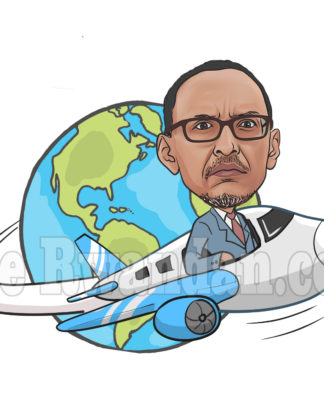
The war is also wreaking havoc on regional economies. The DRC’s decision to close its airspace to Rwandan airlines, particularly RwandAir, is expected to severely impact Rwanda’s aviation sector. RwandAir, which services multiple destinations across Africa and Europe, is already struggling financially. This latest restriction could cripple its operations further. It remains unclear whether this measure was planned in advance or if it was a direct response to Kigali’s refusal to reopen Goma airport. Reports from Lake Kivu confirm that RDF troops continue to enter Congolese territory in significant numbers. Residents have filmed military boats departing from Nyamirundi, in Rwanda’s Nyamasheke District, and heading toward Congolese shores. These reports add to mounting evidence of Rwanda’s direct military involvement in the war.
Meanwhile, ethnic tensions are also being exploited. Moïse Nyarugabo, a prominent Banyamulenge politician, has accused the FARDC of attacking Banyamulenge communities in Minembwe. However, he has not mentioned the role of Twirwaneho, a Banyamulenge militia that has fought against the Congolese army. His accusations were amplified by Rwandan Foreign Minister Olivier Nduhungirehe, raising suspicions that Kigali is using the Banyamulenge issue to justify further military action.