














In an exclusive interview with BBC News, Massad Boulos, Senior Advisor to U.S. President Donald Trump for African Affairs, stated that the recent peace agreement signed between Rwanda and the Democratic Republic of Congo (DRC) “primarily targets the M23 rebel group.” His comments are the clearest indication yet that Kigali’s signature on the deal implies recognition of its influence over M23, a militia largely composed of Congolese Tutsis that reignited its insurgency in late 2021.
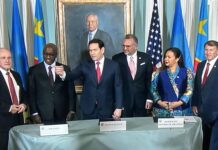
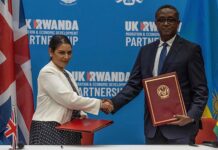
The agreement was signed last Friday in Washington by Rwandan Foreign Minister Olivier Nduhungirehe and his Congolese counterpart Thérèse Kayikwamba, under the auspices of U.S. Secretary of State Marco Rubio. The pact aims to end decades of recurring conflict in eastern Congo, a region rich in mineral resources.
Speaking to BBC Newshour, Boulos affirmed that the disarmament clause in the peace deal directly concerns M23. “Yes, absolutely. It mainly applies to M23 but also to all other armed groups,” he said. He added that this clause ties directly into the ongoing Doha negotiations between the DRC government and M23, mediated by Qatar.
While Rwanda has consistently denied supporting M23, Boulos made it clear: “There’s no doubt that M23 is aided by Rwanda. Nobody denies that. In fact, that’s part of the reason we supported this peace deal.” He further stated that Rwanda’s involvement in the Washington agreement implies “acknowledgement” of this relationship. “Their role is evident. Rwanda has also committed to supporting the Doha talks. It’s clear they wield considerable influence over M23, even though the group is Congolese,” Boulos said.
Rwanda maintains that its concern is the threat posed by the FDLR, a Rwandan Hutu rebel group based in eastern Congo, which it accuses of seeking regime change in Kigali. The peace deal includes a clause obliging parties to dismantle such groups.
Corneille Nangaa, head of the AFC/M23 alliance, recently commented that the Washington agreement only addresses “part of the root causes of the conflict,” reiterating M23’s preference for the Doha process as a more comprehensive solution.
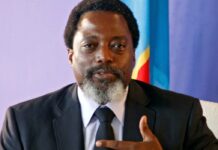
Although hailed by many as a historic breakthrough, the Washington deal has drawn criticism from some quarters. Former Congolese President Joseph Kabila, who ruled from 2001 to 2019, dismissed it as “a commercial agreement” and “diplomatic theatre.” Kabila is currently politically active in M23-held territory in eastern Congo, including the cities of Goma and Bukavu. The DRC Senate recently lifted his parliamentary immunity to allow for a judicial probe into alleged collusion with M23.
In response to such allegations, Boulos insisted: “This is a peace agreement, not a trade deal. Yes, future trade agreements will follow between the two countries, but that is separate.”
Boulos also addressed concerns about the economic dimension of the deal, particularly the processing of Congolese minerals in Rwanda. “The peace accord includes a regional economic framework,” he said. “Both sides agreed to establish a structured mechanism for regional economic cooperation. Rwanda, despite having limited mineral resources of its own, already hosts U.S. mining companies. Under the new arrangement, Rwanda will focus on processing minerals.”
The DRC has long accused Rwanda of looting its natural resources—an allegation Kigali denies.
Pressed on whether the U.S. is effectively rewarding Rwanda’s alleged support to M23, which has been accused of killing thousands of civilians, Boulos replied firmly: “Absolutely not. The most important element of this peace deal is the shared security mechanism agreed upon by both parties. Let’s not forget this is a bilateral peace agreement. We are facilitators, not enforcers.”
He added that if either party violates the agreement, “sanctions” could be imposed, as President Trump emphasised during the signing ceremony.
The peace process is expected to culminate with a high-level summit in Washington, where Presidents Paul Kagame of Rwanda and Félix Tshisekedi of the DRC will meet to finalise the agreement.
This deal, if successfully implemented, could reshape the geopolitics of the Great Lakes region and bring an end to one of Africa’s most intractable conflicts.









 “primarily targets the M23 rebel group.”)