


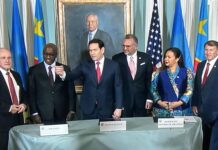




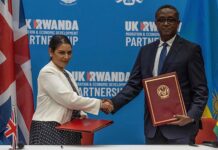









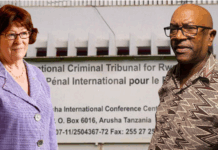






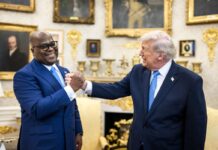
A major step has been taken in Washington in the peace negotiations between the Democratic Republic of the Congo (DRC) and Rwanda. On June 18, 2025, technical teams from both countries initialled the text of a peace agreement, witnessed by U.S. Under Secretary of State for Political Affairs Allison Hooker. The document, the result of three days of talks, is now expected to be signed by foreign ministers and subsequently by heads of state on June 27.
The agreement builds on the Declaration of Principles signed on April 25, 2025, and includes key commitments: respect for territorial integrity, cessation of hostilities, disarmament and demobilisation of non-state armed groups, the creation of a joint security coordination mechanism, the return of refugees and internally displaced persons, humanitarian access, and a framework for regional economic integration. Qatar, acting as co-facilitator alongside the United States, was also present to ensure consistency with ongoing diplomatic efforts.
Despite this progress, tensions remain. A few days earlier, Rwandan Foreign Minister Olivier Nduhungirehe publicly condemned the leaking of draft documents to the media. On June 11, he posted on X: “I hope that those, parties to the ongoing negotiations for a peace agreement between the DRC and Rwanda, who are maliciously leaking unilateral proposals and evolving working documents to the press, understand that they can jeopardise the success of the Washington talks.” His remarks followed a Reuters report claiming the U.S. was pressing for the withdrawal of Rwandan troops from Congolese territory as a condition for finalising the deal.
In another post, Nduhungirehe had already warned that no peace agreement would be signed on June 15, clarifying that while “mid-June” had been the initial target for a White House signing, the date had to be revised to reflect the ongoing nature of the negotiations. According to him, earlier exchanges between Congolese, Rwandan, and American officials had taken place by email, before the talks progressed to in-person meetings at the expert level in Washington.
Pressure remains high, particularly from the American side. The current U.S. administration, represented by Secretary of State Marco Rubio, has reiterated its commitment to a comprehensive, realistic, and mutually beneficial agreement. Washington and Doha are counting on this process to lay the groundwork for lasting peace and security in the Great Lakes region.
However, many analysts remain sceptical of Rwanda’s intentions. Kigali continues to justify its military presence in eastern Congo by citing the threat posed by the FDLR, a militia composed of Rwandan Hutu elements. Yet observers argue that this is more a pretext than a legitimate concern. On the ground, the M23 rebel group – widely reported to receive Rwandan backing – has been strengthening its parallel administration in occupied areas, even though it lacks the manpower to hold the territory effectively without Rwandan military support.
On social media, some supporters of Paul Kagame’s government are increasingly vocal about a hidden agenda. They evoke a return to pre-colonial borders, when parts of what is now eastern DRC were under the control of the Rwandan kingdom. These territorial ambitions, analysts suggest, are largely driven by the economic potential of the region, which is rich in valuable minerals and other natural resources.
The next step will depend on the formal endorsement by foreign ministers, followed by a summit of heads of state in Washington. With only days to go before the planned signing, the peace process appears more tangible than ever – but the true intentions of the parties involved remain a central question.






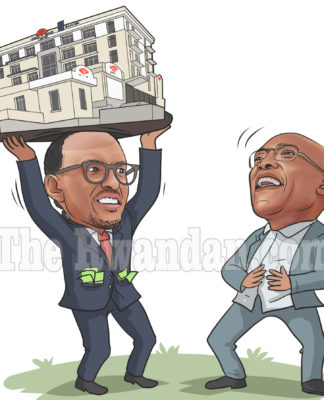






 and Rwanda.)