


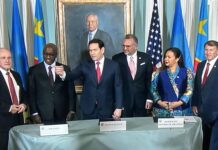








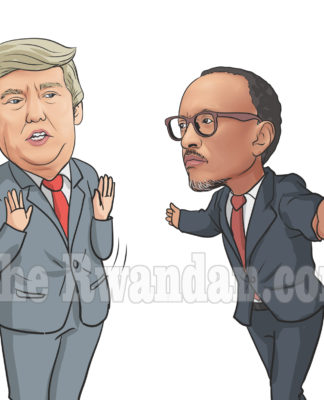
Talks between the Democratic Republic of Congo (DRC) and Rwanda have entered a crucial phase this week in Washington. A second draft peace agreement, more ambitious than the declaration of principles signed last April, is currently under discussion. Multiple diplomatic sources confirm the document was prepared under U.S. supervision and could be signed this summer. Its key condition: the unconditional withdrawal of Rwandan troops and military equipment from Congolese territory — a demand Kigali continues to reject.
Withdrawal as a precondition
According to documents reviewed by RFI and Reuters, the signing of the deal hinges on the complete withdrawal of Rwandan troops, weapons, and equipment from eastern Congo. Rwanda denies having forces there, instead referring to “defensive measures” to protect its own borders. However, numerous reports — including a recent NBC News investigation — allege that over 5,000 Rwandan soldiers have been deployed in support of the M23 rebel group.
The Congolese government, backed by Washington, is holding firm. A senior adviser to President Félix Tshisekedi told Reuters, “We demand the total withdrawal of Rwandan troops as a precondition for signing the agreement, and we will not compromise.”
Kinshasa and M23 talks stalled in Doha
In parallel, direct negotiations between Kinshasa and the M23 took place in Doha throughout May but have yielded no major breakthrough. A source within the M23 delegation told the BBC that Kinshasa refuses to allow any progress unless the rebels first withdraw from major urban centres like Goma and Bukavu. The U.S. draft agreement requires Rwanda to ensure that M23 withdraws from occupied areas in line with terms set out in the Doha process.
Despite nearly 30 days of dialogue, most of the sessions in Doha involved Qatari mediators meeting each side separately. A preliminary proposal was submitted to both delegations, who are now expected to consult their leadership before talks resume.
The FDLR issue on the table
Another central point of the agreement is the dismantling of the Democratic Forces for the Liberation of Rwanda (FDLR). The draft text calls for both states to cooperate in identifying and eliminating these armed elements, following the operational framework agreed in Luanda in October 2024. In return, the DRC would commit to blocking all financial or material support to the FDLR.
Rwanda continues to cite the FDLR as an existential threat, despite analysts saying the group’s military capacity has significantly declined. Kigali justifies its presence in eastern Congo as a preventive measure.
Peace in exchange for investment
U.S. officials, including Trump’s senior Africa adviser Massad Boulos, hope the agreement will pave the way for billions of dollars in American investment in DRC and Rwanda’s mining sectors, particularly in cobalt, copper, lithium, and tantalum. Boulos said Washington aims to finalise the deal within two months, though that timeline appears optimistic given current disagreements.
Kigali denounces leaks
The publication of this draft in the international press has angered Kigali. Foreign Minister Olivier Nduhungirehe accused some stakeholders of intentionally leaking working documents to influence negotiations. He warned that such actions could “undermine the success of the Washington talks.”
Supporters of the Rwandan government argue that the leaks came from journalists critical of Kigali, working for Western outlets.
NBC News investigation: the hidden war
A detailed NBC News investigation adds further weight to the allegations of Rwanda’s involvement. Drawing on satellite images, internal RDF documents, surveillance footage, and witness testimony, the report alleges that Rwanda has deployed thousands of troops in eastern Congo and operates forward bases within DRC territory to support, train, and command M23 fighters.
NBC claims heavy weaponry — including mortars, machine guns, missile launchers, and anti-aircraft systems — was moved into Congo and then returned to Rwanda under cover of night. Fallen soldiers were removed discreetly to avoid detection, with satellite imagery of a Rwandan military cemetery showing over 900 new graves between 2021 and 2024.
An internal RDF report obtained by NBC confirms that two Rwandan soldiers were captured in Congo during a joint operation with M23. The document recommended sanctions against their commanding officer for failing to conceal their identities.
What next?
Should the parties agree in Washington, a ministerial-level meeting could be called, followed by a potential summit between Presidents Tshisekedi and Kagame. The African Union has expressed support for the initiative, with Togolese President Faure Gnassingbé also acting as a regional mediator.
Yet the road to peace remains uncertain. Rwanda continues to deny its involvement, while Kinshasa insists on full withdrawal and a demobilisation of M23 forces. Behind the scenes, regional influence, sovereignty, and access to mineral wealth are the real stakes in this high-level diplomatic gamble.









 and Rwanda have entered a crucial phase this week in Washington. A second draft peace agreement, more ambitious than the declaration of principles signed last April, is currently under discussion. Multiple diplomatic sources confirm the document was prepared under U.S. supervision and could be signed this summer. Its key condition: the unconditional withdrawal of Rwandan troops and military equipment from Congolese territory — a demand Kigali continues to reject.)