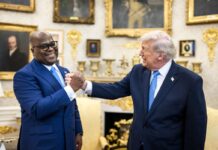

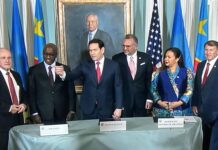




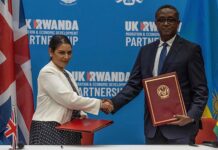











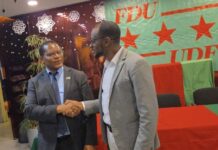



This Friday, 27 June 2025, the Democratic Republic of Congo and Rwanda are expected to sign a long-awaited peace agreement in Washington, D.C., in a ceremony hosted by U.S. Secretary of State Marco Rubio. The event, scheduled for 1:00 p.m. EST at the State Department, will bring together Congolese Foreign Minister Thérèse Kayikwamba Wagner and her Rwandan counterpart Olivier Nduhungirehe. Following the signing, both ministers will be received at the White House by President Donald Trump.
For weeks, the content of the agreement has remained classified, withheld from public scrutiny at the request of U.S. officials. But American researcher Jason Stearns, co-founder of the Congolese research institute Ebuteli and professor at Simon Fraser University, has managed to access and share its general outlines. Speaking to French broadcaster RFI, Stearns explained that the agreement reflects a familiar structure: Rwanda would withdraw its forces from eastern Congo, while the Congolese army would carry out simultaneous operations against the FDLR, a long-standing Rwandan Hutu rebel group based in the DRC.
This mutual commitment is intended to occur in parallel and within a strict three-month window. A joint verification mechanism—comprising representatives from both governments and the United States—would oversee implementation. U.S. intelligence capabilities, including satellite monitoring, are expected to play a role in tracking troop movements and FDLR activity. However, the simultaneous nature of the operations introduces risk: either party can accuse the other of failing to comply, potentially derailing the process.
One of the most sensitive issues in the accord involves the Rwanda-backed M23 rebel group, which currently controls large areas of North Kivu. While M23 was not invited to the signing and remains formally outside the agreement, it is expected that Kigali will pressure the group to withdraw from major cities like Goma and Bukavu. In return, the DRC would permit M23’s political wing to transition into a legitimate political party, while fighters would either be demobilised or selectively integrated into the national army.
This component is controversial, particularly because of M23’s growing entrenchment on the ground. Since capturing Goma, the group has recruited thousands of new fighters, created a parallel administration with tax collection and civil services, and asserted authority over traditional leaders. Dismantling this infrastructure is likely to be far more difficult than any agreement suggests.
Moreover, while the DRC government hopes that the M23 will collapse once Rwandan support is withdrawn, Stearns cautions that this is unlikely. Kigali could also claim it has no control over M23 if the group fails to comply—an assertion many observers view with scepticism, given the longstanding and well-documented ties between the two.
Beyond the military aspects, the agreement has a strong economic dimension. According to diplomatic sources, the deal is backed by promises of major U.S. investment in the mining sector. American companies have shown interest in Congo’s reserves of cobalt, tantalum, lithium and gold, but prefer the minerals to be processed and exported through Rwandan facilities. This arrangement would create mutual dependency and, in theory, incentivise both governments to maintain peace.
A second agreement on regional economic integration is expected to follow, pending progress in separate peace talks in Doha between the DRC and M23 representatives. U.S. officials see these talks as essential to the broader framework. The deal initialled by technical experts last week reportedly includes clauses on respect for territorial integrity, disarmament of non-state actors, and a phased process for reintegration.
Yet despite the high-level diplomacy, many experts remain deeply sceptical. The DRC reportedly dropped a key demand for immediate Rwandan withdrawal to unblock the talks. Analysts suspect Rwanda is merely buying time under U.S. pressure, with a longer-term aim of consolidating influence—or even de facto control—over eastern Congo. The region’s strategic value, both in military and mineral terms, is too great to be ignored.
Some Congolese and international critics have warned that Rwanda’s true goal is to maintain a permanent presence in the Kivus, a region once part of the pre-colonial Rwandan kingdom. They argue that the M23’s administrative structure is not temporary but part of a deliberate project of political and territorial expansion.
For now, the world awaits the formal signing of the accord, just hours away. If the parties follow through on their commitments, and if international actors can enforce the deal, it could mark a rare step toward stability in a region torn apart by decades of war. But as history has shown, a signed document is only the beginning.