





By Ben Barugahare
Bukavu, the capital of the South Kivu province in the Democratic Republic of Congo (DRC), fell on Sunday, February 16, 2025, under the control of elements of the AFC/M23 and the Rwandan Defense Forces (RDF). The Rwandan forces and the M23, coming from the north, exhausted and in small numbers, awaited reinforcements arriving from Cyangugu, Rwanda, during the night before deploying into the city on Sunday morning. By 10 a.m., the M23 soldiers, supported by Rwanda, controlled the Rusizi I border following the flight of Congolese immigration officers who had abandoned their posts since Friday.
As of today, the AFC/M23 and the Rwandan army hold several strategic points in eastern DRC: the borders of Ishasha, Kitagoma, and Bunagana with Uganda, the border of Goma with Rwanda, and now that of Bukavu.
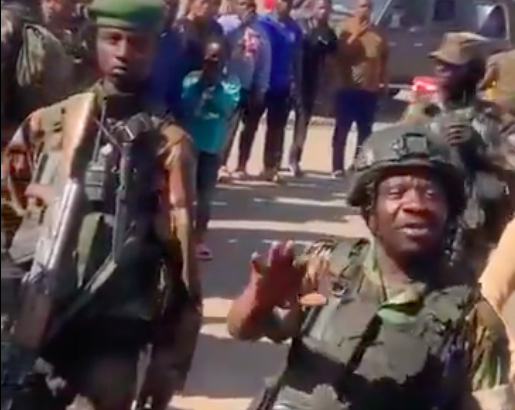
In Bukavu, the rebels also took control of the residence of the governor of South Kivu. They were seen in several neighborhoods, notably at Independence Square, where they held an improvised meeting.
Some clashes were reported, particularly at Camp Panzi on the Rusizi II border, between elements of the AFC/M23 supported by the Rwandan army and the FARDC. These battles caused several casualties and injuries among civilians, further destabilizing the region.
While the Congolese presidency asserted on Saturday night that Bukavu was under the control of the Armed Forces of the DRC (FARDC) and the Wazalendo militias, images and videos circulating on social networks confirmed the actual presence of the M23 and Rwandan troops in various strategic areas of the city. Several sources claim that the FARDC redeployed in the city retreated during the night, leaving the ground open to the assailants.
International reactions were swift. French President Emmanuel Macron announced that he had spoken with Félix Tshisekedi and called for the immediate withdrawal of the M23 from Bukavu and Kavumu Airport. The African Union, through Bankole Adeoye, Commissioner for Peace and Security, denounced a risk of the DRC’s balkanization and demanded an immediate withdrawal of the occupying forces. The UK Foreign, Commonwealth & Development Office (FCDO) deemed the entry of the M23 and RDF into Bukavu a violation of Congolese sovereignty and an escalation threatening regional stability. The European Union, through its spokesperson Anouar El Anouni, expressed concern about the capture of Bukavu by the M23 forces supported by Rwanda. The EU stressed that the violation of DRC’s territorial sovereignty would not go unanswered and called for an immediate ceasefire.
Constant Mutamba, Minister of Justice and Keeper of the Seals of the DRC, reacted forcefully, calling on the Congolese people to resist the invaders. He denounced Rwanda’s involvement and the complicity of some internal traitors. He declared, “The strongest army in the world remains the people,” emphasizing the need for national mobilization against the occupation.
A Munyamulenge notable, Moïse Nyarugabo, addressed an open letter to Burundian President Evariste Ndayishimiye, denouncing the mass arrests of Congolese and Rwandan nationals in Bujumbura, claiming it was a discriminatory roundup against his community. He requested the immediate release of these individuals and urged authorities not to conflate civilian populations with the security situation in eastern DRC.
For his part, Burundian President Evariste Ndayishimiye declared that Burundi was ready for any potential external aggression, implicitly accusing Rwanda of seeking to destabilize his country. He warned against any attempted attack, stating that “Burundians will not be victims like the Congolese” and that his army was prepared to defend national sovereignty. However, Burundian authorities clarified that the arrests only concerned undocumented foreigners in an irregular situation, rejecting any accusations of targeted persecution.
The Archbishop of Kinshasa, Cardinal Fridolin Ambongo, urged the Congolese people to remain cautious and pray amid the prevailing uncertainty in eastern DRC. In a message to the faithful, he denounced the threats against religious infrastructures and called for respect for freedom of worship, while emphasizing the necessity of peace and national cohesion. The Catholic and Protestant churches called for prayer and vigilance as threats against religious buildings continued to emerge.
In Uvira, a Congolese police officer was assassinated by Wazalendo militiamen who suspected him of being Tutsi due to his tall stature and facial features, although he was not.
In Bukavu, chaos has taken hold. The central prison has been emptied of its detainees, with no clear information on whether they were released, transferred, or escaped. Looting has been reported in Bralima warehouses and in the storage facilities of the World Food Programme (WFP). The increased presence of weapons among civilians worsens the situation, with several young individuals aged 13 or 14 spotted handling firearms in the city.
General Bernard Byamungu, one of the key figures of the M23 under French sanctions, held a meeting in Bukavu where he accused First Lady Denise Tshisekedi, a native of South Kivu, of failing to defend the interests of her home region. He also justified the M23’s presence by accusing Kinshasa of recruiting child soldiers, which he considers a crime against humanity.
Rwandan authorities, Kigali-based media, and pro-Kagame influencers have been actively promoting propaganda in favor of M23 against the governments of the DRC, Burundi, and South Africa. Rwanda’s Foreign Minister Olivier Nduhungirehe frequently intervenes in Congolese internal discussions, with some Congolese internet users nicknaming him “the Congolese political opposition figure.”
At the diplomatic level, Belgium and Germany firmly condemned the M23 offensive and called for the immediate withdrawal of Rwandan troops. Ugandan General Muhoozi Kainerugaba, son of President Yoweri Museveni, threatened military intervention in Bunia against any armed group refusing to surrender. He publicly expressed his support for M23 and Rwanda through several messages on his X account
The Congolese opposition, through the voices of Martin Fayulu and Franck Diongo, denounced President Tshisekedi’s inability to protect the country.